SOUTH AMERICA: Calls for Justice for Peru's Native Peoples
By Franz Chávez*
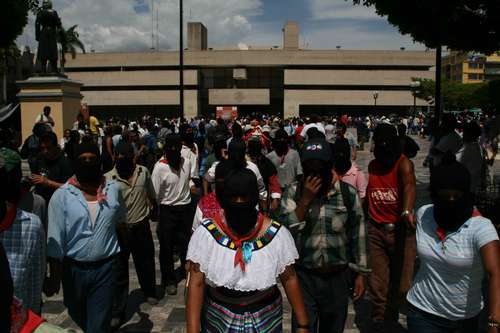
LA PAZ, Jun 12 (IPS) - Social organisations in South America are backing the struggle against opening up Peru’s Amazon jungle to mining and oil companies, which resulted in clashes in which at least nine indigenous people and 25 police officers died.
The recent violence near the town of Bagua, in the northern Peruvian province of Amazonas, is seen by indigenous organisations in Bolivia, Colombia and Ecuador as an attack on people who are defending life, nature, human rights and the rational use of natural resources.
Native communities in the Peruvian rainforest are demanding the repeal of a series of decrees issued by the García administration to promote foreign investment on indigenous lands, in the framework of the free trade agreement signed with the United States.
A two-month protest by indigenous people outside the northern Peruvian town of Bagua ended in bloodshed on Jun. 5, when the police violently broke up a roadblock there.
A multi-party parliamentary committee declared in December that the decrees in question are unconstitutional, as the native groups argue.
In an open letter to the region's presidents, the Confederation of Indigenous Nationalities of Ecuador (CONAIE) called on them to defend native peoples and confirm their commitment to peace and justice in South America.
A congress of the Indigenous Confederation of Indigenous People of Bolivia (CIDOB) urged the United Nations and the Organisation of American States to send a team of investigators to Bagua to verify what happened there on Jun. 5.
While official accounts say that nine indigenous people and 25 members of the police were killed, eyewitnesses who have spoken to the press say the bodies of indigenous protesters were thrown into the river from a helicopter.
"We consider this violent action by the Peruvian government to be a massacre and a flagrant violation of the life, integrity and fundamental rights of indigenous communities," said the Colombian National Authority of Indigenous Government (ONIC) in a letter to President García.
"We join our voices to the Amazonian indigenous communities who are demanding an end to the violation of their rights and the repeal of the free trade agreement decrees that open the doors to the invasion and plundering of their territories.
"We condemn the violent actions of the Peruvian government against our peoples," says the letter, which also calls for medical attention for the injured and policies to prevent a repeat of the incident.
García's response to the violence was to allege that "foreign meddling" was behind the protests in the Amazon. He later specifically mentioned Bolivia’s left-wing president, the first indigenous leader of that country.
In the midst of the political crisis triggered by the violent incident, García accused Morales of inciting the protests by means of an "inflammatory" letter sent to the Fourth Continental Summit of Indigenous Peoples, held May 29 in the Peruvian city of Puno, on the border with Bolivia.
Although he was the most important guest invited to the summit, Morales merely sent a letter by the hand of Senator Leonilda Zurita of his governing Movement to Socialism (MAS), who is an activist for women's rights and political and trade union freedoms.
The meeting, held on Peruvian soil but only 200 km west of La Paz, brought together native leaders of the Americas, called Abya Yala in precolonial times.
"That meeting discussed uprisings and insurgency," García maintained. "A president of a neighbouring country sent messages about our countries being governed by indigenous peoples, who are victims of exploitation and utterly neglected, which is not true, because the statistics on employment and welfare have improved in the jungle areas."
In La Paz, Bolivian Vice President Álvaro García Linera, a recognised champion of indigenous rights, said in reply that "letters do not kill," referring to the violence unleashed in the Peruvian Amazon.
"We confirm the contents (of the letter) and we are proud of every word and every letter in it," said the deputy minister for coordination with social movements, Sacha Llorenti, one of Morales’ closest associates.
"From resistance we have gone on to rebellion, and then to revolution. This is the second independence," said Llorenti, in support of Morales' policy of nationalising Bolivia’s abundant natural gas reserves, which were handed over by previous governments to foreign companies.
"It is difficult to rebuild what has been destroyed over 25 years of neoliberal, free market policies," Llorenti said.
Morales' letter to the indigenous leaders' summit also says "free trade agreements break up harmonious human relationships with nature; they commodify natural resources and national cultures; they privatise basic services; they try to patent life itself."
"Some people think globalisation means they have a right to interfere in the politics of neighbouring countries, "said García. "That is regrettable. If they wish, I can interfere too (in Bolivian affairs) and I know how to do so. I don't think it's democratic or legal or positive for international relations."
Sociologist Carlos Laruta, the head of the Centre for Research and Advancement of Peasant Farmers (CIPCA) in the impoverished city of El Alto, Bolivia, said that it is up to Morales to explain the intention of his letter, because he is the representative of a state and therefore subject to the rule of international law.
"A president cannot do things that run counter to international law," Laruta said.
Anthropologist Martín von Hildebrand, winner of the 1999 Alternative Nobel Prize, said the root problem is that the rights of Peruvian indigenous peoples to their ancestral territories have not been recognised in practice, as they have in other countries that share the Amazon basin: Brazil, Bolivia, Colombia and Ecuador.
"When you look at a big map of the Amazon basin, you can see that Brazil has given indigenous peoples a territory as large as Colombia itself (1.1 million square kilometres)," he said, while Colombia has given them 27 million hectares, and Bolivia and Ecuador have also made progress.
"If you look at a government map of Peru, marking potential lumber, oil, gas and mineral extraction, the country's Amazon area is completely covered with marks," said von Hildebrand, who is also head of the Gaia Amazonas Foundation, which works to strengthen indigenous culture and autonomy as a strategy for preserving the rainforest.
* With additional reporting by Constanza Vieira (Bogotá) and Ángel Páez (Lima).
__________________________________________________________
Copyright 2009: IPS-Inter Press Service
Native Rights News is making this material from [name of news source] available in accordance with the Fair Use Doctrine codified at Title 17 U.S.C. Section 107: This article is distributed without charge or profit to those who have expressed a prior interest in receiving the included information. Distribution of this material is for research and educational purposes that will promote social and economic justice and benefit society.
____________
Native Rights News (NRN) is published by the Alliance for Indigenous Rights, a nonprofit corporation owned and operated by Temple Beit Shem Tov as part of its Peace and Justice Ministry.
Monday, September 28, 2009
Failure of Peruvian Government to Recognize Indigenous Rights to Ancestral Lands at Heart of Recent Massacre
Read more!


Tuesday, June 23, 2009
Peruvian Army Sent to Suppress Peaceful Indigenous Protests Against Resource Extraction in Amazon Basin
Amazon Watch: Oil Production Interrupted as Peru Sends in Army to Suppress Peaceful Indigenous Protests
LIMA, Peru, May 19 /PRNewswire-USNewswire/ -- The Peruvian government Saturday authorized the intervention of armed forces in the Amazon to crack down on growing indigenous protests against new decrees aimed at facilitating the entry of oil, mining, logging and agricultural companies into indigenous lands without prior consultation or consent.
On Monday, sustained protests led the state oil company, Petroperu, to shut down its main oil pipeline. This shutdown comes after a month of protests by more than 30,000 indigenous peoples. Indigenous communities have engaged in peaceful actions and blockades of roads and rivers throughout the Amazon protesting new legislation passed to facilitate the Free Trade Agreement with the USA that undermines their rights.
Videos and photos available on http://www.amazonwatch.org/ show police beating peaceful protesters and firing rubber bullets to break up peaceful Awajun and Huambis demonstrators last week when they blockaded the Corral Quemado Bridge near the northern town of Bagua, resulting in dozens injured and one person missing, who is feared dead.
In a statement, Alberto Pizango, president of the national indigenous rights organization AIDESEP who was criminally charged today for his role in the nationwide protests, stated: "The extraction of gas and oil, logging and the dredging of rivers in search of gold are destroying in a few years social structures, indigenous customs and coexistence strategies that date back thousands of years."
International and Peruvian human rights organizations are widely criticizing the Peruvian government's backward policies on indigenous peoples. In a recent statement President Alan Garcia said that every Peruvian should be entitled to benefit from the nation's natural resources, and not just a "small group of people who had the fortune to be born there."
Atossa Soltani, who heads the human rights and environmental organization Amazon Watch, commented, "Indigenous Peoples are asserting their collective right to determine how and under what conditions 'development' is carried out on their traditionally owned and legally recognized homelands."
"The Garcia Administration is clearly out of step with international conventions on indigenous rights that have been ratified by Peru, not to mention aspects of country's own Constitution. We urge the government of Peru to use restraint and avoid bloodshed, seeking meaningful dialogue to resolve the conflict instead."
__________________________________________________________
© 2000-2009 Amazon Watch
Native Rights News is making this material from Amazon Watch available in accordance with the Fair Use Doctrine codified at Title 17 U.S.C. Section 107: This article is distributed without charge or profit to those who have expressed a prior interest in receiving the included information. Distribution of this material is for research and educational purposes that will promote social and economic justice and benefit society.
____________
Native Rights News (NRN) is published by the Alliance for Indigenous Rights, a nonprofit corporation owned and operated by Temple Beit Shem Tov as part of its Peace and Justice Ministry.
Read more!
Thursday, April 9, 2009
Declaration of the International Conference on Extractive Industries and Indigenous Peoples
23-25 March 2009
Legend Villas, Metro Manila, Philippines
We, Indigenous Peoples and support organisations from 35 countries around the world and representing many more Indigenous Nations, have gathered together in this International Conference on Extractive Industries and Indigenous Peoples. As Indigenous Peoples we have a unique cosmic vision, diversity of languages, histories, spirituality and territories which have existed since time immemorial. However, we now find ourselves within the borders of States which have established norms and laws according to their interests. On account of this situation, we have suffered disproportionately from the impact of extractive industries as our territories are home to over sixty percent of the world's most coveted mineral resources. This has resulted in many problems to our peoples, as it has attracted extractive industry corporations to unsustainably exploit our lands, territories and recourses without our consent. This exploitation has led to the worst forms of, environmental degradation, human rights violations and land dispossession and is contributing to climate change.
Environmental degradation includes, but is not limited to, erosion of our fragile biological diversity, pollution of land, air and water, and destruction of whole ecological systems. Extractive industries, and particularly those relating to fossil fuels, also have significantly contributed to the climate change that is destroying our Mother Earth.
Human rights violations range from violations of Indigenous Peoples' right to self-determination (which includes the right to determine one's own economic, social and cultural development), rights to lands, territories and resources, as well as displacement and violations of the most basic civil and political rights, such as arbitrary arrests and detention, torture, enforced disappearances and killings.
Our cultural diversity has also been grossly eroded because of the destruction of biological diversity and lands, territories and resources by extractive industries upon which our cultures are based. This erosion of our cultural diversity is also a result of the imposition of colonial systems and the settlement of non-Indigenous Peoples. Corporations enter into our territories with the promise of “development” through employment, infrastructure building and payment of governmental taxes. Despite these promises, there still exists a situation of dire poverty in those living close to extractive industry projects. This situation has fuelled conflicts between Indigenous Peoples and the State and extractive industry corporations, as well as causing divisions within the Indigenous communities themselves.
On 6-16 May 1996, a first “Mining and Indigenous Peoples Conference” held in London produced the “Indigenous Peoples' Declaration on Mining”. This declaration highlighted conflicts occurring between our communities and corporations. It reiterated that Indigenous Peoples need to be the decision makers on whether or not mining should take place in their communities and under what conditions this may occur.
Almost 13 years have passed since this conference was held, but overall our situation on the ground has not noticeably improved. The opportunities and threats since the 1996 conference include:-
• the welcome adoption of the United Nations Declaration on the Rights of Indigenous Peoples (UN DRIP) by the UN General Assembly on 13 September 2007;
• new UN mechanisms for the protection of the rights of Indigenous Peoples, such as the UN Permanent Forum on Indigenous Issues, the Special Rapporteur on the situation of human rights and fundamental freedoms of indigenous people, and the Expert Mechanism on the Rights of Indigenous Peoples;
• a greater interest on the relationship between human rights and corporate behaviour, including the work of the UN Special Representative of the Secretary General on the issue of human rights and transnational corporations and other business enterprises;
• the recognition of corporate social responsibility and a claimed willingness on behalf of corporations to negotiate agreements directly with Indigenous Peoples, although so far much of this seems to be more on paper or promises, as opposed to practice;
• the climate change crisis, coming about mainly because of dependence of the current economy on fossil fuels. These resources are mined on our land and many of our peoples are disproportionately affected by such activities; and
• the global financial crisis, caused by the unregulated liberalisation of finance.
Based on the foregoing observations, we assert that:-
• Indigenous Peoples are rights holders, with an inextricable link to their lands, territories and resources which they have traditionally owned, occupied or otherwise used or acquired, and should not be treated merely as stakeholders. We have a right to self-determination of our political condition and to freely choose our economic, social and cultural development (UN DRIP Article 3);
• our rights are inherent and indivisible and seek recognition not only of our full social, cultural and economic rights but also our civil and political rights;• all doctrines, policies and practices based on the presumed superiority of colonial peoples and worldviews should be condemned;
• we contribute to the diversity and richness of the cultures that make up humanity and believe that we can teach valuable lessons to the rest of the world through our values and world views in how to tread gently upon the earth;
• destruction of Indigenous Peoples sacred sites and areas of spiritual and cultural significance by extractive industries must stop;
• the vulnerable position of women and youth with regard to the impacts of extractive industries, including loss of livelihoods, violence and impacts on health and well-being must be recognized;
• the development model premised on unsustainable consumption and production, and corporate globalisation, which fuels the entry of extractive industries onto our lands must be rejected;
• respect for the preservation of life on earth, and our right to food, must have precedence over extractive industry projects;
• extractive industry projects must not take precedence over our right to land - regardless of whether our rights are based on legal recognition or usufruct rights;
• there must be an immediate end to the criminalization of community resistance, the violent intimidation, harassment, and murder, of our leaders, activists and lawyers who are working for the defence of our lands and lives;
• extractive industry projects must not take precedence over the human right to water. Water is especially important in our lives and is sacred to us. In addition the major reserves of fresh water are found in our territories;
• the right to water is a fundamental human right which must be recognized. We therefore condemn the conduct of the World Water Council which demotes the right to water a “basic need”;
• negotiations about climate change should not be conducted by States and international organisations unless there is full and effective participation of Indigenous Peoples. Furthermore, mitigation and adaptation measures related to climate change must be designed and implemented in keeping with Indigenous Peoples' rights;
• the failure to hold extractive industries to account in host and home countries must be addressed and mechanisms for accountability and enforcement must be created immediately; and
• implementation of interstate infrastructure initiatives - such as the South American Regional Infrastructure Initiative (IIRSA) - that lead to mega-projects on our lands and territories without first obtaining our free prior and informed consent (FPIC) are destructive to our cultures and survival, and a denial of our right to self determination.
Given the above, in order to ensure respect for the rights recognized in the UN DRIP, as well as the ecological integrity of our planet and communities, we call for:-
• a stop to the plunder of our lands, territories and resources;
• a moratorium on further extractive industry projects that affect or threaten our communities, until structures and processes are in place that ensure respect for our human rights. The determination of when this has been realized can only be made by those communities whose lives, livelihoods and environment are affected by those projects;
• due process and justice to victims of human rights violations who are resisting extractive industries;
• review of all on-going projects that are approved without respect for our FPIC and self determination rights; and
• compensation and restitution for damages inflicted upon our lands, territories and resources, and the rehabilitation of our degraded environments caused by extractive industry projects that did not obtain our FPIC.
We call on Indigenous Communities and their Supporters:-
• to create an international mechanism working on extractive industries and Indigenous Peoples aimed at sharing information, education, advocacy and the defence of our rights;
• to coordinate research on mining companies, processes and investment sources to empower communities, build strategic plans and ensure recognition and respect for our rights;
• to assert their right to control the authorization of projects, and where FPIC has been given, the conduct of extractive activities in indigenous lands and territories through the use of indigenous customary laws;
• to create a mechanism to compile legal precedents from relevant court decisions on Indigenous Peoples and extractive industries;
• to build relationships with non-indigenous groups concerned with the problem of extractive industries, nationally and internationally, to find common ground; and
• to establish a International Day of Action on Extractive Industries and Indigenous Peoples.
We call on Civil Society Organisations:-
• to increase their support, and solidarity in a manner that is sensitive to the issues of Indigenous Peoples;
• especially conservation and other NGOs, not to impose themselves or their views upon us, but respect our legitimate leadership and also seek the FPIC of communities before intervening; this also applies to academics including anthropologists; and
We call on Companies:-
• to respect international standards on rights in all jurisdictions, especially the minimum standards as set forth in the UN DRIP, which includes in particular, the right to lands, territories and resources and attendant right to FPIC. This also applies to consultants;
• to submit to independent and credible monitoring;
• to be accountable for the environmental disasters, destruction and human rights violations as a result of their operations;
• to employ proven technology and adhere to the precautionary principle at all levels and in each project;
• to recognize the specific vulnerability of indigenous women to the negative impacts involved with extractive industries;
• to ensure full transparency in all aspects of their operations, and especially to ensure affected communities have full access to information in forms and languages they can understand; and
• to conduct and implement environmental, social, cultural and human rights impact assessments to the highest international standards ensuring independent review and participation of indigenous peoples;
We call on Investors:-
• to ensure that policies in relation to investments in indigenous territories reflect the rights articulated in the UN DRIP, and that the ethical index listings used should base their investment recommendations on third party information, as opposed solely to information from the company in which they may invest and
• not to invest in fossil fuel related projects.
We call on States:-
• specifically those States that have not done so yet, to adopt the UN DRIP and ratify International Labour Organization (ILO) 169, and for those States who have to uphold the rights articulated therein;
• to establish, in consultation with Indigenous Peoples, clear mechanisms and procedures at national levels for the implementation of international juridical instruments, specifically the UN DRIP, ILO 169 and International Convention on the Elimination of All Forms of Racial Discrimination (ICERD);
• to review laws and policies on extractive industries that are detrimental to Indigenous Peoples, and ensure consistency with the UN DRIP and international instruments protecting Indigenous Peoples rights;
• to recognize and enforce the rights Indigenous Peoples to FPIC as laid out in UN DRIP, in accordance with our customary laws and traditional practices;
• to recognize and ensure the demarcation and titling of our ancestral lands;
• to recognize our customary laws and traditional mechanisms of conflict resolutions;
• to support the efforts of Indigenous Peoples to develop economic alternatives to extractive industries, in order to alleviate the poverty that creates false dependencies on extractive industries;
• to abolish hedge funds and all forms of private equity that are not transparent and well regulated, and which distort the price of minerals;
• to legislate and regulate thorough processes for independently conducted environmental, social, cultural and human rights impact assessments, with regular monitoring during all of the phases of production and rehabilitation;
• to protect indigenous activists, human rights defenders and lawyers working on human rights issues, and where the State is the violator we demand an end to the violations against our peoples;
• to ban particularly harmful extractive practices, including riverine tailings disposal, gas flaring, effluent discharges, submarine tailings disposal, mountain top removal and large scale open-pit mining. Given the risks posed by climate change, serious re-consideration should be given to the construction of tailings containment in low-lying coastal areas and in areas exposed to increasingly severe weather events and
• to ensure that their development cooperation policies and programmes respect Indigenous Peoples rights’, in particular in the context of extractive industries and our right to FPIC.
We call on the UN Permanent Forum on Indigenous Issues (PFII):-
• to request that the UN Indigenous Peoples Expert Mechanism conduct a study, with the participation of Indigenous Peoples, on the impact of extractive industries on them, by consolidating all recommendations, observations and decisions of UN Treaty and Charter bodies pertaining to the subject and identifying the measures taken by States to adhere with these;
• to request that UN mechanisms, agencies and bodies promote the elaboration of mechanisms and procedures for States to implement to minimum standards set forth in the UN DRIP, including in particular the right to FPIC;
• to establish procedures which provide indigenous communities with the opportunity to request the relevant UN agencies to assist them in the monitoring and provision of independent information in FPIC processes;
• to support the Indigenous Peoples’ proposal that there be an international Mother Earth Day, and encourage all UN agencies, mechanisms and bodies to do likewise;
• to demand the full and effective participation of Indigenous Peoples in all discussions and decisions pertaining to international agreements and conventions that address issues of biological diversity and or climate change;
• to emphasize the need to address the direct and indirect impacts of extractive industry on climate change, including those associated with mitigation measures;
• to emphasize the need for the widespread diffusion of information and critical debate between Indigenous Peoples about the ongoing mechanisms and negotiations relative to carbon trading and the carbon market;
• to request that the Special Representative to the Secretary General on the issue of human rights and transnational corporations and other businesses, John Ruggie, and other UN organisations, bodies and agencies, promote the enactment of legislation in home states of transnational corporations that provides for extraterritorial jurisdiction in relation to their activities;
• to recommend that the World Bank Group update its operational directives and safeguard policies pertaining to Indigenous Peoples to include the right to FPIC, as required under the UN DRIP;
• to recommend that the World Bank Group immediately stop funding, promoting and supporting fossil fuel related projects and large scale mining projects on indigenous lands, and provide a set timeline for ending of all such funding;
• to recommend that the World Bank stop influencing the design of national policies in developing countries in a manner that promotes the interests of transnational mining corporations over the rights of indigenous communities;
• to recommend that the World Health Organisation consider conducting a study on the impact of cyanide and heavy metals on the right to health of communities impacted by mining;
• to address the urgent need for the genuine recognition of indigenous religious, cultural and spiritual rights, including their sacred sites in the context of extractive projects and
• to recommend that all bilateral agreements should guarantee that indigenous peoples’ human rights are respected.
__________________________________________________________
Source: Unrepresented Peoples and Nations Organization (UNPO)
Native Rights News is making this material from UNPO available in accordance with the Fair Use Doctrine codified at Title 17 U.S.C. Section 107: This article is distributed without charge or profit to those who have expressed a prior interest in receiving the included information. Distribution of this material is for research and educational purposes that will promote social and economic justice and benefit society.
____________
Native Rights News (NRN) is published by the Alliance for Indigenous Rights, a nonprofit corporation owned and operated by Temple Beit Shem Tov as part of its Peace and Justice Ministry.
Read more!
Tuesday, February 17, 2009
Ecuador Ratifies World's First Constitution to Give Rights to Nature
 In Ecuador, Trees Now Have Rights
By Gar Smith Earth Island Journal, Winter 2009
On September 29, the Associated Press reported that Ecuador's new constitution would "significantly expand leftist President Rafael Correa's powers." It wasn't until the end of a 15-paragraph article that the AP mentioned the new constitution – approved by 65 percent of voters – "guarantees free education through university and social security benefits for stay-at-home mothers." Also missing from the AP's report: any mention that Ecuador's voters had just ratified the world's first "eco-constitution," a pioneering document that, for the first time in human history, extends "inalienable rights to nature."
Not too long ago, Ecuador would have seemed an unlikely nation to become the birthplace of Earth's first green constitution. To service its massive debt to US creditors, the World Bank and the International Monetary Fund forced Ecuador to open its pristine Amazon forests to foreign oil companies. Nearly 30 years of drilling enriched ChevronTexaco, desecrated the northern Amazon, and utterly failed to improve the lives of millions of poor Ecuadoreans. Amazon Watch estimates that Texaco damaged 2.5 million acres of rainforest, left the landscape pitted with 600 toxic waste pits, and polluted the rivers and streams that some 30,000 people rely on. Cancer rates in the area where Texaco operated are 130 percent of the national norm, and childhood leukemia occurs at a rate four times higher than in other parts of Ecuador.
In 1990, the Siona, Secoya, Achuar, Huaorani, and other Indigenous forest-dwellers won title to three million acres of traditional forestland, but the government retained rights to the minerals and oil. In November 1993, Indigenous communities filed a $1 billion environmental lawsuit against Texaco, and Indigenous groups subsequently demanded a 15-year moratorium on drilling, environmental reparations, corporate indemnification, and a share of oil profits.
In 1997, when Ecuador's pro-US government announced plans to rev up oil exploitation by a third, all eyes turned to the Yasuni Rainforest, home to the country's largest oil reserve – estimated at 1 billion barrels. The Yasuni is also home to rare jaguars, endangered white-bellied spider monkeys, spectacled bears, and Indigenous tribes protected by international treaty.
In 2007, the new government of President Rafael Correa announced plans to halt oil exploration in the Yasuni, an action Amazon Watch called "a giant first step toward breaking Ecuador's dependence on oil." Correa's proposal marked a shift to making renewable energy the new path for Ecuador's economic future. The language in the new constitution takes the new policy several steps further.
Ecuador's radical new constitution features a chapter on the "Rights for Nature" that begins by invoking the Indigenous concept of sumak kawsay (good living) and the Andean Earth Goddess: "Nature, or Pachamama, where life is reproduced and exists, has the right to exist, persist, maintain and regenerate its vital cycles, structure, functions and its processes in evolution." The constitution contains a Nature's Bill of Rights that includes "the right to an integral restoration" and the right to be free from "exploitation" and "harmful environmental consequences."
Surprisingly, there is a US connection to this story. The Pennsylvania-based Community Environmental Legal Defense Fund (CELDF), along with the San Francisco-based Pachamama Alliance, spent a year working with Ecuador's 130-member Constituent Assembly to craft the language that installed ecosystem rights in the heart of the new constitution.
"Today's environmental laws are failing," CELDF observes in a section on its Web site. "By most every measure, the environment today is in worse shape than when the major US environmental laws were adopted over 30 years ago." CELDF notes that US regulations "treat nature as property under law. These laws legalize environmental harm by regulating how much pollution or destruction of nature can occur." They don't forbid pollution, they merely "codify it." By contrast, Right of Nature laws challenge property law by "eliminating the authority of a property owner to interfere with the functioning of ecosystems that exist and depend upon that property for their existence and flourishing." The idea is gaining momentum. Municipalities in Pennsylvania, California, New Hampshire, and Virginia have adopted Right to Nature laws in recent years.
Shannon Biggs of Global Exchange notes "slaves were once also considered property under the law" until Americans understood "we needed to write new laws in order to change … the cultural climate."
With parrot-flecked jungles containing more than 300 different tree species per hectare, cloud forests of amazing biodiversity, and a border that extends to the Galapagos Islands, Ecuador is the perfect spot for the world's first eco-constitution. Ecuador has swung a hammer against the chains designed to keep nature in thrall to commerce. It's time for other nations to pick up the same hammer.
__________________________________________________________
Copyright Earth Island Journal 2009
Native Rights News is making this material from Earth Island Journal available in accordance with the Fair Use Doctrine codified at Title 17 U.S.C. Section 107: This article is distributed without charge or profit to those who have expressed a prior interest in receiving the included information. Distribution of this material is for research and educational purposes that will promote social and economic justice and benefit society.
--
Posted By Alliance for Indigenous Rights to Native Rights News at 1/20/2009 07:45:00 AM
Read more!
Republic of Lakota Fights Uranium Mining in the Black Hills
January 12, 2009 by admin
For the past two years we have been asking that letters be sent to South Dakota Governor Mike Rounds requesting a moratorium on further uranium development until the old mines are cleaned up. He has always replied in the negative. Therefore we are now approaching the South Dakota legislature who is starting their sessions in Pierre, SD.
Enclosed are two form letters addressed to Representatives Hunhoff and Lange. The facts in the form letters are based on studies and research. It would greatly help these two representatives if they could approach their colleagues with hundreds of letters asking for a moratorium on further uranium development. Please make copies of the enclosed letters and have your friends and relatives sign them, then send them immediately to Bernie Hunhoff and Gerry Lange. Let's get as many letters to them as possible. Anyone living anywhere can send a letter because the uranium is used all over the world in power plants or weapons.
If you live in South Dakota, it would also help if you would send a similar letter, or group of letters, to your own state Senator or Representative as well as these letter to Hunhoff and Lange. Letters to the Editor of South Dakota newspapers are also needed. Please also consider sending a letter to the editor encouraging a moratorium on further nuclear development in SD.
Together, we can all make our environment safe from nuclear radiation by starting at where the nuclear cycle starts with the exploration and mining.
Thank you.
Charmaine White Face, Coordinator
__________________________________________________________
Copyright © 2008 · Republic of Lakotah
Native Rights News is making this material from the Republic of Lakota available in accordance with the Fair Use Doctrine codified at Title 17 U.S.C. Section 107: This article is distributed without charge or profit to those who have expressed a prior interest in receiving the included information. Distribution of this material is for research and educational purposes that will promote social and economic justice and benefit society.
--
Posted By Alliance for Indigenous Rights to Native Rights News at 1/14/2009 07:57:00 AM
Read more!
Tuesday, January 13, 2009
Conflict Over Mining Deepens Between Correa Government and Indigenous Peoples and Environmentalists
| Ecuador Anti-Mining Blockades Met With Repression, National Mobilization Called for January 20 |  |  |
| Written by Daniel Denvir, Photographs by Ximena Warnaars | |
| Friday, 09 January 2009 | |
|
The government of President Rafael Correa has assumed an aggressive posture, insulting indigenous and environmental activists and pledging to secure approval for a controversial new Mining Law. Canadian companies hold the majority of mining concessions in Ecuador and are pressing for a new law that would allow for large-scale, open pit metal mining.
Protesters also argue that the law contradicts important provisions of the new constitution protecting water, the environment and indigenous peoples’ rights. The document drew international attention for awarding legal rights to nature. The new constitution, approved by popular referendum in September, is the centerpiece of Correa’s first term. After emergency meetings on January 7, the Confederation of Indigenous Nationalities of Ecuador (CONAIE) called for a national mobilization on January 20, calling the government “dictatorial.” It is unclear whether the January 20 mobilization will spread road blockades to other provinces in central and northern Ecuador. Protesters are demanding a dialogue with central government leaders and for a broad national discussion on mining before any legislation is passed. Some protesters in the Southern provinces of Zamora Chinchipe and Morona Santiago suspended their blockades for 24 hours in response to the provincial governor’s promise to reach out to Francisco Cordero, the President of the Congresillo, Ecuador’s interim legislature. Other blockades were suspended in anticipation of the nationwide actions. The blockades began on Monday January 5 in the Southern province of Azuay, cutting off much of the traffic into and out of Cuenca, Ecuador’s third largest city. Over the next few days, the protests spread to the neighboring Andean province of Loja and to the Amazonian provinces of Zamora Chinchipe and Morona Santiago.
On January 6, campesino leader Vicente Zhunio Samaniego was arrested in the Southern province of Morona Santiago, showing up 16 hours later in a hospital with bullet wounds to the head. On January 7, protest leader Miguel Ángel Criollo and his son Orlando were arrested in an early morning raid on the village of Pueblo Nuevo in Azuay province. The newspaper El Universo reports that over fifty police officers from the Special Operations Group (GOE) took part in the raid. When villagers tried to defend the Criollos from arrest, police fired tear gas, forcing the evacuation of a local school. In the city of Cuenca, police violently repressed protests at the Court of Justice. As six leaders began a hunger strike inside the building, the police attacked a press conference taking place outside the building, arresting Water Board leader Carlos Pérez Guartambel. Police used tear gas to disperse protesters attempting to defend Pérez. Police then forced hunger strikers and four women supporting them out of the Court building, dragging them by their necks. The governor of Azuay denied that Pérez was arrested, and he was freed later that day. The six hunger strikers are now in Cuenca’s San Roque Church. According to the newspaper El Comercio, Minister of Mines and Petroleum Derlis Palacios said that the government would push forward with the Mining Law. Palacios said that Ecuador “was a poor country that could not afford to just sit on these large resources.” He added that protests were the result of manipulation by indigenous leaders who mislead community members by claiming that mining would harm their access to clean water. Palacios said that the new law would ensure that water sources are protected. Congresillo President Cordero told El Comercio that protesters were using the demonstrations to advance electoral ambitions. The CONAIE condemned the government’s description of protesters as “criminals and subversive terrorists,” saying that “the only thing we are fighting for is life and dignity for all of Ecuador’s citizens.” The CONAIE that such comments are aimed “to stigmatize [protesters] and prepare public opinion for even more severe repression.” Correa is coming into increasing conflict with social and indigenous movement activists. On Thursday January 8, the United Labor Front (FUT), Ecuador’s largest labor federation, announced mass protests for a higher minimum wage increase for January 15. They say that Correa’s proposed increase of $18 a month, to $218, is a step back and fails to meet provisions in the new constitution ensuring that all Ecuadorians are paid a living wage. Ximena Warnaars is an anthropologist and PhD student from the University of Manchester, UK living in Cuenca, Ecuador. Daniel Denvir is a Quito, Ecuador based journalist in the process of moving to Philadelphia, and a 2008 recipient of NACLA's Samuel Chavkin Investigative Journalism Grant. He is an editor at www.caterwaulqu |
 The ongoing conflict over mining in Ecuador escalated this week as blockades shut down highways throughout the country’s Southern Andean highlands and Amazon rainforest, while nationwide protests have been called for January 20.
 A number of leaders have been arrested and other protesters were beaten and shot at by police. Campesino and indigenous protesters, who depend on clean water to farm and for drinking water, are demanding that the government shelve President Rafael Correa’s proposed Mining Law, saying that it would be a social and environmental disaster. The rural blockades follow months of regular protests in Quito and other parts of the country
 In Giron, Molleturo, Tarqui (Azuay), Limon Indanza (Morona Santiago) and in El Pangui (Zamora Chinchipe) protestors have been beaten or shot by police. Police officials and journalists were released after being briefly detained by campesinos.
__________________________________________________________
© 2009 Upside Down World
Native Rights News is making this material from Upside Down World available in accordance with the Fair Use Doctrine codified at Title 17 U.S.C. Section 107: This article is distributed without charge or profit to those who have expressed a prior interest in receiving the included information. Distribution of this material is for research and educational purposes that will promote social and economic justice and benefit society.
Read more!
Monday, January 12, 2009
Ecuadorian Government Debates Law Favoring Canadian Mining Companies over Constitutional Rights of Nature and Indigenous Tribes

By Daniel Denvir, Today correspondent
The Mining Law, currently under debate in the provisional National Assembly, or Congresillo, would replace the Mining Mandate passed in May of this year. The Mandate froze mining operations and revoked a number of concessions to foreign corporations. The law would create a National Mining Company and increase state control over foreign corporations, which are largely Canadian. But the law would also allow mining to take place anywhere, including in protected areas and sharply limit community input.
In Quito, buses arrived from throughout the country to protest the mining law. Marching to the National Assembly, protesters clashed with police, who used pepper spray to push back activists intent on meeting with legislators. A small delegation was allowed to enter in the afternoon. The protests were organized by the Confederation of Indigenous Nationalities of Ecuador (CONAIE) and the Coordinator for the Unity of the Left and for Life, a new organization dedicated to regrouping social movements to confront Correa.
The march is possibly a prelude to a nation-wide uprising. While the protest was not large by Ecuadorian standards, representatives from many communities were present. Earlier this month, more than 30 organizations gathered in the Amazonian city of Coca and agreed to oppose Correa’s business friendly policies. Former Correa spokesperson and Assembly Member Monica Chuji said, “Today is a first step in a broader process of unifying social movements. Today we don’t have quantity, but we have unity.” Chuji, an Amazonian Kichwa, broke with Correa’s Alianza País Party in September, accusing the president of opposing indigenous rights.
Correa insists that responsible mining is necessary for Ecuador’s development. In November, Correa accused the indigenous movement of “losing their compass and playing into the hands of sectors that they have historically criticized, such as the Right, which the current administration is combating.” Correa has threatened to send the Mining Law to a national referendum if the indigenous movement alters it or blocks its approval, accusing the CONAIE of being anti-democratic.
But Dr. Byron Real López, an expert in environmental law, wrote in a recent report that the Mandate “is concerned with solving important issues. ... such as the corruption surrounding the indiscriminate granting of concessions. But the proposed law ignores the ecological and social conflicts that mining activity causes. ... and thus would tend to aggravate them.” López argues that the proposed law would violate a number of provisions in the new constitution, such as those protecting the rights of nature and indigenous communities.
Juan Francisco, a young Kichwa, traveled from the Southern province of Cañar. “We will never let them into our territory, which provides our water. Responsible mining is a miserable lie that the government wants to sell to us.” Juan Francisco said that the government should instead support sustainable and organic farming.
“We oppose the Mining Law because we love nature. Mining will kill us, it will poison the water with chemicals. We all drink this water and we all will die. Water doesn’t belong to anyone. It belongs to us all.”
Despite Correa’s dismissive comments, it appears that the government is taking the movement seriously. Two days after the protests Ecuador’s interim legislature, the Congresillo, announced that they were considering extending discussion on the law by seven days – potentially pushing back a vote until Jan. 12. On Dec. 26, Congresillo President Francisco Cordero began a series of meetings with social movement leaders opposed to the project. The stated objective is to incorporate critics’ perspectives before the proposal undergoes a second debate, the last step before a vote.
But the CONAIE demands that the law be shelved so that a national debate on mining can take place. And protesters were adamant in their opposition to large-scale mining.
Carmen, a Saraguro Kichwa woman from the Southern province of Loja, said, “We oppose the Mining Law because we love nature. Mining will kill us, it will poison the water with chemicals. We all drink this water and we all will die. Water doesn’t belong to anyone. It belongs to us all.”
Campesino Jorge Marin traveled hours by bus from the Southern Amazonian province of Morona Santiago. “We’re here to stop the Mining Law, a law that will make it impossible for us to be owners of our land. We are here to defend nature and let the Congress know that we depend on the Amazon for life.”
Leaders of the CONAIE were scheduled to meet in a special assembly the first week of January to discuss a possible national uprising.
Salvador Quishpe, a Kichwa leader from the Southern Amazonian province of Zamora Chinchipe, told the crowd that mass mobilization would be necessary to stop the Mining Law. “If we have to celebrate Christmas in the streets to stop this law, we will!” Quishpe said that while it was impossible to bring thousands of people from Zamora Chinchipe to Quito, 1,500 delegates met in his province earlier this month and declared their support for nation-wide mass mobilizations.
© 1998 - 2009 Indian Country Today
Native Rights News has adapted and is making this material from Indian Country Today available in accordance with the Fair Use Doctrine codified at Title 17 U.S.C. Section 107: This article is distributed without charge or profit to those who have expressed a prior interest in receiving the included information. Distribution of this material is for research and educational purposes that will promote social and economic justice and benefit society.
Read more!
Thursday, January 8, 2009
Nicaragua Finally Complies with Order of Inter-American Court of Human Rights and Grants Awas Tingni Title to Ancestral Lands
 | UNITED NATIONS |
UN expert praises
confirming land ownership for
indigenous group
The Special Rapporteur congratulated the Government of Nicaragua on completing the demarcation and titling of the lands of Awas Tingni, a Mayangna community that is one of the many indigenous communities that populate the country's
On
This was the first case in which an international tribunal with legally binding authority found a government in violation of the collective land rights of an indigenous group, setting an important precedent in international law.
The Special Rapporteur was present at the titling ceremony on Sunday, along with several government dignitaries and indigenous leaders who traveled to the remote community for this momentous event. He stated there that, "The titling of Awas Tingni's lands reflects a commitment on the part of the Nicaraguan Government to implement the judgment of the
The Special Rapporteur calls upon the Government of Nicaragua to continue to advance the human rights of indigenous peoples in the country and to address their ongoing concerns in accordance with international standards.
________________________________________________________
Commentary by Perry H. Chesnut, Editor, NRN
The Inter-American Court of Human Rights, headquartered in San Jose, Costa Rica, exists to interpret and enforce the provisions of the American Convention on Human Rights. Created by the Organization of American States in 1977, this autonomous judicial body has no jurisdiction over any member state of the OAS unless that state has signed the American Convention on Human Rights. To date, Canada has declined to ratify the Convention, and despite the fact that the United States signed the Convention in 1977, and despite the fact that noted American legal scholar and jurist Thomas Buergenthal sat on the Court from 1979 through 1991 and served as its President from 1985 through 1987, the United States has never ratified the Convention. The legal effect of this is that the Inter-American Court of Human Rights has no jurisdiction to hear or decide cases of alleged violation of human rights by Canada or the United States - even though they are members of the OAS.
This is just one more example of the jarring clash between our governments' propaganda about protecting the human rights of their citizens and the actual facts. Imagine, for example, if the United States were tried for the 1993 mass murder of its own citizens at Waco, Texas (54 adults and 22 children members of the Branch Davidian religious sect), or for the FBI's 1979 murder of Native American rights activist John Trudell's mother-in-law, pregnant wife and three children. Nope, it's unimaginable for at least two reasons: (1) we're the good guys, remember? Our government would never assassinate its own citizens for target practice or political payback. And (2), just in case anyone disagrees that we're the good guys, we're the most powerful nation on earth, and we're never going submit to the jurisdiction of any court put together by a bunch of two-bit Latin-American countries. They can do that to themselves if they are so inclined, but we - the UNITED STATES OF AMERICA - are different. We are the exception to the rules that govern other lesser peoples and nations and can do anything we want to. And if we do it, that automatically makes it right and not subject to question, debate or review by anyone except ourselves. In fact, we are a rule unto ourselves.
Having said that, I want to end on a brighter note by emphasizing the power of international public and legal opinion on the actions of national governments, including those of the United States, Canada, Australia and New Zealand, the only four nations to vote against the United Nations Declaration on the Rights of Indigenous Peoples (UN DRIP), adopted by the UN General Assembly on September 13, 2007. The erosion of goodwill toward and respect for the United States by the world community over the last eight years has been enormous, with international polls showing that many people believe that the United States has lost its moral compass and many others naming our country as the "most dangerous country in the world." Our own citizenry's awareness of the decline of U.S. moral and ethical authority, both domestically, and with respect to its standing in the world community is one of the main reasons for the wholesale repudiation of the Bush Administration and Republican Party and their doctrines - all of which have the purpose of making the entire planet and 95% of its population subject and subservient to the insatiable greed of the now global corporations and the 2% of the world's population who own and manage them. The tide of world opinion is turning against those who would destroy the earth, its climate, and the indigenous people who understand the interrelationship of the earth and all living beings and who view cooperation, sharing, and the maintenance of balance and harmony as spiritual obligations. And so this legal case and Nicaragua's compliance with its decision are two more thorns in the heel of global corporate capitalism. Slowly, like the drip, drip, drip of water on a rock, international legal decisions and international public opinion will wear away the grip unrestrained capitalism has on the citizens and institutions of our own nations (U.S., Canada, Australia and New Zealand). There is good reason for optimism.
Read more!
Thursday, December 18, 2008
Video of Hugo Blanco's Speech on Indigenous Struggles in the Western Hemisphere

Hugo Blanco Galdos, has been an activist his entire life. In the 1960s he led the Campesino movement and coined the famous chanted slogan for the movement: "Land or Death!" In his later years, he has returned to his roots as an indigenous Peruvian Indian and is championing the rights of South American Indians to remain on their lands and pursue ecologically sound development. He currently is publishing a magazine titled Lucha Indigena (Indigenous Struggle). We have included the following capsule biography from Wikipedia.
Following the capsule biography are YouTube videos of the speech he delivered last year at Simon Fraser University in Vancouver, B.C.
_________________________________________________________
Hugo Blanco
From Wikipedia, the free encyclopedia
Hugo Blanco Galdos is a Peruvian political figure and leader of the Campesino Confederation of Peru.
In the early 1960s he led the Quechua peasant uprising in the Cuzco region of Peru. Captured by the military, he was sentenced to 25 years imprisonment on the island of El Frontón. During his imprionsment he wrote Land or Death: The Peasant Struggle in Peru.
Blanco was released from prison and expelled to Sweden in 1976[1] following an international solidarity campaign that included Jean-Paul Sartre, Simone de Beauvoir, and Bertrand Russell. After spending several years of exile in Sweden, Mexico and Chile he returned to Peru in 1978, was a founder of the Workers Revolutionary Party and was elected to parliament on a left-wing slate.[2]
He served in the Peruvian Senate as a representative of the Partido Unificado Mariateguista until 1992 when he fled to Mexico where he was granted asylum following[3] due to Alberto Fujimori's "self-coup" and declaration of a state of emergency.[4]
Hugo Blanco is currently Director of a Cusco-based newspaper called Lucha Indigena.
This article is also licensed under the GNU Free Documentation License. It uses material from the Wikipedia article "Hugo Blanco"
Read more!
Tuesday, December 16, 2008
Mexican Development Plans Threaten Land and People of Chiapas
IntercontinentalCry.org
December 12, 2008
Threatening the Land and People of Chiapas
by Ahni (John Schertow) The Mexican government has announced plans to bring ‘progress’ and ‘development’ to Chiapas, under the renewed “Plan Puebla Panama” scheme, now called the “Mesoamerica Initiative.”
“A renewed push to exploit and destroy the land and people of Chiapas,” says rootforce, the plan involves the ‘four horsemen of Chiapas’: mining, infrastructure, bio-fuel, and oil.
For some time now Chiapas has been faced with major challenges surrounding minerals exploitation, particularly from Canadian mining companies, who, as we should all know well by now, “are notorious throughout Latin America [and the rest of the world] for their ruthless eviction of traditional communities and for their devastation and pollution of lands and rivers,” says Jessica Davies.
This is precisely what awaits Chiapas where “there are apparently 55 new mining applications pending… for the exploration and extraction until 2056 of gold, silver, copper, barite, lead, titanium, iron, zinc, antimony, molybdenum, and other minerals needed for the oil industry,” Davies adds.
Regarding infrastructure, the government wants to help the extractive industry and expand tourism by constructing roads, bridges, and various other developments.
For instance, in the Northern part of Chiapas, a so-called “eco-archaeological tourism” theme park is currently in the works.
Located at the pre-colonial Mayan city of Palenque, the ‘them park’ will consist of “[a highway and 3 bridges] as well as hotels, restaurants, related businesses and an expansion of the Palenque Airport,” according to the Chiapas Support Comittee. “The highway and other construction will cut through and divide the land of the living Maya while facilitating the tourist exploitation of [their ancestors].”
Plans for the final two ‘horseman’ - oil and bio-fuel - were announced by the Mexican Energy Secretary Georgina Kessel, on November 21.
Kessel said that in 2009, Pemex, Mexico’s state-owned oil company, would be allowed to start prospecting and drilling for oil in the Lacandon rain forest, among other areas.
Kessel further announced a plan to produce bio-diesel in Chiapas, using a plant called “Jatropha curcus.”
Also known as the “Black Vomit Nut” Jatropha is a very controversial plant because of its highly toxic properties. Consuming as few as three of its seeds can be fatal to humans.
Overall, this four-part scheme, which has been pledged to “save the economy” and bring “progress and development for the benefit everyone,” implies “very serious threats to the rich biodiversity of the state of Chiapas and to the rights and the lands of the indigenous peoples of the region,” states the NGO ‘Maderas del Pueblo’ in a November 23 communique.
With it, “the federal and state governments have shown that they have embarked on a ’schizophrenic demagogy’ in which, at the same time as they announce policies, programmes and ‘green’ resources to tackle climate change, there is an obvious contradiction as they are clearly demonstrating themselves in favour of a return to a savage capitalism, of a short-term and extractive character, together with the interests of grand capital, of the biotechnology and pharmaceutical sectors, of those producing bottled water and all those keen to convert wood and forest cover into ’sinks’” for the multinational carbon market; of all those hiding behind a disguise of green philanthropy and supported by cross-governmental, national and international organisations, and calling themselves ‘conservationists’, and who have been encouraging and applauding the official policy of pillaging and plundering the biodiverse indigenous territories and turning them into ‘Protected Natural Areas’ ‘for the benefit of humanity’,” Maderas del Pueblo continues.
“The basic question [now] is: Will the indigenous people and campesino communities, with their lands, natural resources and rights all threatened, permit this proposed plunder to take place?”
photo:redamazon.wordpress.com
__________________________________________________________
Article originally published by intercontinentalcry.org
Native Rights News is republishing this article under the terms of a Creative Commons Attribution-Noncommercial-Share Alike 2.5 Canada License.
Read more!
Monday, December 15, 2008
Climate Proceedings Refuse Recognition of Tribal Peoples' Rights to the Forests They Live In
UN talks on climate change exclude tribal peoples
Survival International
12 December 2008 Tribal representatives at the UN conference on climate change in Poznan, Poland, have slammed the proceedings for excluding indigenous voices and refusing to recognise tribal peoples’ rights to the forests they live in and protect.
The United States, Australia, New Zealand and Canada acted together to delete all reference to tribal peoples’ rights in a draft agreement prepared for the conference. All four countries also refuse to sign the UN Declaration on the Rights of Indigenous Peoples, and none have ratified the international law for tribal peoples, known as ILO 169.
The Poznan draft agreement sets out how an international scheme to Reduce Emissions from Deforestation and Degradation (REDD) could be implemented. It had initially referred to ‘noting the rights and importance of engaging indigenous peoples’, but rights are not mentioned in the amended version.
The REDD scheme, where rich industrialised countries pay less industrialised countries to keep their forests intact, is rapidly becoming a centrepiece for global action on climate change, and is expected to form a large part of whatever agreements replace the Kyoto Protocol when it runs out in 2012.
The scheme risks seriously damaging tribal peoples’ lives and health, unless their rights to the land are recognised and respected at the outset. Research has shown that one of the best ways to protect the rainforest is to protect the rights of the people living in it. 162 million hectares of the Amazon rainforest have been recognized as indigenous territories, and are secured against deforestation.
Davi Yanomami, a Yanomami shaman from Brazil, has said ‘The forest cannot be bought; it is our life and we have always protected it. Without the forest, there is only sickness, and without us, it is dead land. Give us back our lands and our health before it’s too late for us and too late for you.’
The lands of many tribes remain unprotected, and even land which has already been recognised is under threat. The Indians of Raposa Serra do Sol are reaching the end of a battle in the Supreme Court of Brazil to maintain recognition of their land after a powerful consortium of farmers and politicians tried to overturn the demarcation.
Spread the message share this story
Delicious Digg reddit Facebook StumbleUpon
___________________________________________________
© Survival International, 2008
Native Rights News is making this material from Survival International available in accordance with the Fair Use Doctrine codified at Title 17 U.S.C. Section 107: This article is distributed without charge or profit to those who have expressed a prior interest in receiving the included information. Distribution of this material is for research and educational purposes that will promote social and economic justice and benefit society.
Read more!