IntercontinentalCry.org
December 12, 2008
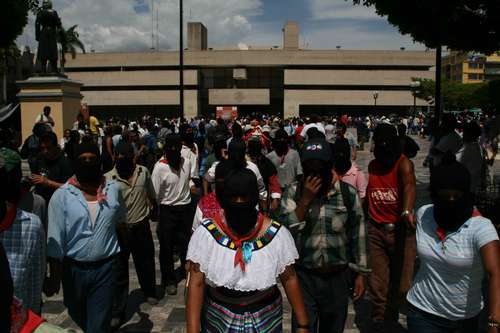
Threatening the Land and People of Chiapas
by Ahni (John Schertow) The Mexican government has announced plans to bring ‘progress’ and ‘development’ to Chiapas, under the renewed “Plan Puebla Panama” scheme, now called the “Mesoamerica Initiative.”
“A renewed push to exploit and destroy the land and people of Chiapas,” says rootforce, the plan involves the ‘four horsemen of Chiapas’: mining, infrastructure, bio-fuel, and oil.
For some time now Chiapas has been faced with major challenges surrounding minerals exploitation, particularly from Canadian mining companies, who, as we should all know well by now, “are notorious throughout Latin America [and the rest of the world] for their ruthless eviction of traditional communities and for their devastation and pollution of lands and rivers,” says Jessica Davies.
This is precisely what awaits Chiapas where “there are apparently 55 new mining applications pending… for the exploration and extraction until 2056 of gold, silver, copper, barite, lead, titanium, iron, zinc, antimony, molybdenum, and other minerals needed for the oil industry,” Davies adds.
Regarding infrastructure, the government wants to help the extractive industry and expand tourism by constructing roads, bridges, and various other developments.
For instance, in the Northern part of Chiapas, a so-called “eco-archaeological tourism” theme park is currently in the works.
Located at the pre-colonial Mayan city of Palenque, the ‘them park’ will consist of “[a highway and 3 bridges] as well as hotels, restaurants, related businesses and an expansion of the Palenque Airport,” according to the Chiapas Support Comittee. “The highway and other construction will cut through and divide the land of the living Maya while facilitating the tourist exploitation of [their ancestors].”
Plans for the final two ‘horseman’ - oil and bio-fuel - were announced by the Mexican Energy Secretary Georgina Kessel, on November 21.
Kessel said that in 2009, Pemex, Mexico’s state-owned oil company, would be allowed to start prospecting and drilling for oil in the Lacandon rain forest, among other areas.
Kessel further announced a plan to produce bio-diesel in Chiapas, using a plant called “Jatropha curcus.”
Also known as the “Black Vomit Nut” Jatropha is a very controversial plant because of its highly toxic properties. Consuming as few as three of its seeds can be fatal to humans.
Overall, this four-part scheme, which has been pledged to “save the economy” and bring “progress and development for the benefit everyone,” implies “very serious threats to the rich biodiversity of the state of Chiapas and to the rights and the lands of the indigenous peoples of the region,” states the NGO ‘Maderas del Pueblo’ in a November 23 communique.
With it, “the federal and state governments have shown that they have embarked on a ’schizophrenic demagogy’ in which, at the same time as they announce policies, programmes and ‘green’ resources to tackle climate change, there is an obvious contradiction as they are clearly demonstrating themselves in favour of a return to a savage capitalism, of a short-term and extractive character, together with the interests of grand capital, of the biotechnology and pharmaceutical sectors, of those producing bottled water and all those keen to convert wood and forest cover into ’sinks’” for the multinational carbon market; of all those hiding behind a disguise of green philanthropy and supported by cross-governmental, national and international organisations, and calling themselves ‘conservationists’, and who have been encouraging and applauding the official policy of pillaging and plundering the biodiverse indigenous territories and turning them into ‘Protected Natural Areas’ ‘for the benefit of humanity’,” Maderas del Pueblo continues.
“The basic question [now] is: Will the indigenous people and campesino communities, with their lands, natural resources and rights all threatened, permit this proposed plunder to take place?”
photo:redamazon.wordpress.com
__________________________________________________________
Article originally published by intercontinentalcry.org
Native Rights News is republishing this article under the terms of a Creative Commons Attribution-Noncommercial-Share Alike 2.5 Canada License.
Tuesday, December 16, 2008
Mexican Development Plans Threaten Land and People of Chiapas
Read more!


Thursday, December 11, 2008
Maori Leader Addresses Global Forum for Bioethics in Research
Sharples: Global Forum for Bioethics in Research
Thursday, 4 December 2008, 9:17 am
Speech: The Maori Party
Ninth Global Forum for Bioethics in Research
Orakei Marae; Auckland;
Wednesday 3 December 2008; 7pm
Hon Dr Pita Sharples, Co-leader of the Maori Party
[NRN Editor's Note: Following is the text of the speech Dr. Pita Sharples, Co-leader of the Maori Party gave on December 3, 2008 to the Ninth Global Forum for Bioethics in Research held in Auckland, New Zealand.]
This is a fantastic time to be holding this ninth global forum on bioethics in research.
The last three months, in particular, have been unprecedented in terms of the acts of resistance and celebration initiated by indigenous peoples and members of vulnerable populations.
On 23 September in New York, Bolivia’s first indigenous president, Evo Morales called a press conference at the United Nations, telling the General Assembly it was meeting at a time of rebellion against poverty, misery and the effects of climate change and privatization policies throughout the world.
He spoke about the uprisings of indigenous peoples and farmers questioning the effects of economic systems such as those of the World Bank and the International Monetary Fund - and he went further and suggested it was those privatization policies that had caused the current financial crisis.
Just over a week later, this time in Geneva, a statement from the Aotearoa Indigenous Rights Trust; the International Alliance of Indigenous and Tribal Peoples of the Tropical Forest and Te Runanga o Nga Kaimahi Maori o Aotearoa Te Kauae Kaimahi was presented, calling for a transparent process to support the Expert Mechanism on the Rights of Indigenous Peoples.
The collective intervention, called for guidelines to be created about how research would be carried out, to ensure a legitimate body for indigenous people was built, and its research reports acted upon by the United Nations and States.
The third turning point came just over a month later, at a time when Kenya declared a national day of celebration; a public holiday to celebrate the election of Barack Obama to the US presidency.
And Nelson Mandela, South Africa's first black president, sent a letter of congratulations, stating:
"Your victory has demonstrated that no person anywhere in the world should not dare to dream of wanting to change the world for a better place”.
Finally, here in Aotearoa, the Māori Party, the independent voice of Māori in Parliament, succeeded in bringing a fifth MP into the Beehive after our recent election; and just a fortnight ago, signed a relationship agreement with the National Party, which symbolized our willingness to be part of Government, in our efforts to do all that we can to uphold the aspirations of our people.
These acts of resistance, these opportunities for celebration, create a brilliant foundation in which to discuss respectful research.
They represent uprisings of indigeneity; of the first nations people across the world daring to dream we can change the world for a better place. And here we are tonight, daring to dream that the research world will continue to inspire us to do so.
The developments that have occurred over these last months on the global stage provide a rich environment to discuss the next stages of our development - the ways in which our traditional beliefs and values, our cultural norms - are upheld in ethical research.
But there is one more context that I want to draw to your attention, in my capacity as the Member of Parliament for Tamaki Makaurau.
And I turn to mihi to the mana whenua of this land, Ngāti Whatua o Orakei.
Half a century ago, the hapū lived peacefully on their papakainga land in Okahu Bay, in the haven of their whare tūpuna - Te Puru o Tamaki. That was, until the Government of the day decided to evict the people from their homes, burn their marae, homes and buildings to the ground, and relocate the people to an allotment of state houses. They were left virtually landless.
In 1976, the Crown moved to make its final nail in the coffin, to dispose of the last sixty acres of uncommitted land at Orakei. And then came the uprising. For 506 days, Ngāti Whatua, under the leadership of Joe Hawke, occupied the point, Takaparawhau - or Bastion Point.
On 25 May 1978, the largest mobilization of Police and army forces in New Zealand’s history was directed to Bastion Point, to evict the people for trespassing on their own land. 222 people were arrested, the photographs and memories of that time still linger on as we recall the kuia and kaumatua, the elderly of the tribe, dragged off their land, crying and digging their heels in with all their force.
In time, Ngāti Whatua took a claim to the Waitangi Tribunal, standing up for the return of the 700 acre Orakei Block. In 1991, the Orakei Act was passed, returning the marae, the papakinga lands, the church and the urupa to Ngāti Whatua o Orakei - but also importantly, the Government put on record, it had failed to keep its part of the Treaty of Waitangi, the promise to protect the rights and property of the indigenous peoples.
This year, we marked thirty years since that police raids on Orakei, and we celebrated the resistance of Ngāti Whatua in protecting and preserving their land, their language, their customs, their cultural heritage.
It is not my place to tell the stories of Ngāti Whatua - but there will be many others here who can take you on that journey back through time, and I would encourage you to take that time to also share your stories, the stories from Africa, Asia, Canada, America, Australia, Europe and the Pacific.
Our histories, our stories, our aspirations, our troubles are unique to us as indigenous peoples and members of vulnerable populations.
My hope for this conference is that we leave no-one in any doubt, that the context for any research involving us, must be set by us.
I read a statement the other day from Luther Standing Bear, Chief of the Oglala Sioux. He said, and I quote:
“Only to the white man was nature a ‘wilderness’ and only to him was the land ‘infested’ with ‘wild’ animals and ‘savage’ people. To us it was tame”.
Never again will we return to the days when the people of the land are suppressed; their stories obliterated; their cultures denigrated.
Never again, will we permit anyone to call us savage; not one more acre will be stolen from us; we will not be defined as ‘other’; marginalized as minorities; alienated from our territories.
We have come too far, and we are not going back.
We must have courage, and not fear the backlash from standing out in the crowd, from speaking out.
This is where forums like this are so vital, to keep our spirits high, to uplift us, to inspire us, to consolidate in solidarity.
bell hooks reminds us it will not be easy. She said:
“the space of radical openness is a margin - a profound edge. Locating oneself there is difficult yet necessary. It is not a safe place. One is always at risk. One needs a community of resistance”
This forum is a mark in the sand, a profound edge - to encourage the world research communities, to develop practical measures to promote research which is more ethical.
We need to have the strategic strength to face the risks, to move forward.
Just as Evo Morales acted on the calling of his people to issue his challenge in New York, we must all be bold enough to act with integrity in setting and upholding policy on research ethics.
Just as Ngāti Whatua o Orakei prepared and researched claims and invested in the legislative process; research practitioners and professionals must uphold and adhere to guidelines involving consent, access and participation for indigenous and vulnerable groups.
Having strategic strength is knowing what procedures and protocols we can call on, to provide guidance on the involvement of indigenous peoples in research, intellectual property and traditional knowledge.
74 years ago, Te Rangihiroa (Sir Peter Buck) wrote to Sir Apirana Ngata, saying
“I have come to the conclusion that the Pākehā attitude towards native races is on the whole saturated with the deepest hypocrisy…..even in ethnology, I doubt whether a native people is really regarded as other than a project to give the white writer a job and a chance for fame”. [Sorrenson Vol 3, 1982:126]
This is no doubt a reoccurring theme in the tribal narratives across the globe, that many indigenous peoples would share in common.
But what we know now, is that we are at a turning point where the nature of knowledge and knowing is in our hands. We must invest in strategies which affirm our own whānau, hapū and iwi self-determination; our rangatiratanga.
We must be vigilant to ensure that the theories, methods and research tools are those that extend indigenous knowledge, that serve the interests of the people being researched.
We must draw on our creativity as the means of building resilience within our whānau. We must embrace our indigenous resources - our songs, our poetry, our arts and crafts, our tribal histories, our archives - as a way of distinguishing our research as our own.
And we must insist that the highest form of knowledge and knowing is ultimately used to liberate ourselves, to set ourselves free.
___________________________________________________
[Source: Scoop.co.nz]
Native Rights News is making this material from Scoop Independent News available in accordance with the Fair Use Doctrine codified at Title 17 U.S.C. Section 107: This article is distributed without charge or profit to those who have expressed a prior interest in receiving the included information. Distribution of this material is for research and educational purposes that will promote social and economic justice and benefit society.
Read more!
Wednesday, December 10, 2008
First Nations Chiefs to Seek Help from Obama on Canadian Oil Exploitation
Canadian Indigenous Community to Deliver Message of Oil and Human Rights to President-Elect Obama
WINNIPEG, Manitoba, Dec. 8 /PRNewswire/
In the tradition of delegations of American Indians traveling in the late 1800s to Washington, DC to meet the "Great White Father," Chiefs from Canada's First Nations will be traveling to the U.S. capital to seek the support of President Elect Obama in their fight for Human Rights. A First Nations delegation of Chiefs from across Canada will be in Washington D.C. on January 8th 2009, 12 days before the Inauguration of President-Elect Obama.
Chiefs from the seven First Nations of Treaty One announced a decision to assemble the delegation of Chiefs to deliver a message of oil and human rights to President-Elect Obama. Chief Glenn Hudson of Peguis First Nation, a spokesman for Treaty One stated "We are hopeful that President-Elect Obama will embrace the attitude of respect, compassion and support by engaging in the accountability of equitable and fair trade between the United States, the Indian Nations and the Canadian Government."
During the election campaign President-Elect Barack Obama talked of his concerns with "dirty oil" from Canada and made a lot of positive statements on a new relationship with Native Americans. "Canada is the largest foreign supplier of oil to the United States," added Chief Hudson. "America needs to purchase 14 million barrels of foreign oil every day, and maintaining a steady supply of oil is a national security issue for the U.S. So far, Canada pays little or no royalties to indigenous people for resources."
According to the U.S. Energy Information Administration, over eighty percent of all Canadian exports flow to the U.S. Canada remained the largest exporter to the U.S. of total petroleum in September, exporting 2.364 million barrels per day. The second largest petroleum exporter to the U.S. was Saudi Arabia with 1.431 million barrels per day.
Two major pipelines, the Enbridge Alberta Clipper and the TransCanada Keystone Project, being constructed through three provinces will, by 2012, carry an additional 1.9 million barrels of oil per day to the U.S. The two pipelines are of grave importance to American energy needs given the increasing instability of other foreign sources of oil. Canada supplies the United States with 65% more oil per day than Saudi Arabia, yet the stability of oil supply from Canada has never been of concern to Americans.
In September, two blockades by First Nations in the Province of Saskatchewan sent shockwaves through the industry as construction was halted for four and six days at two sites. Chief Barry Kennedy of Carry the Kettle First Nation (Treaty Four) and Chief Sheldon Wuttunee of Red Pheasant First Nation (Treaty Six) in Saskatchewan organized the blockades. The First Nations are currently in negotiations with the pipelines.
Treaty One will send invitations to Chiefs from all three prairie provinces, Alberta, Saskatchewan, and Manitoba. Invitations will also go to British Columbia where First Nations are fighting the proposed Gateway Pipeline. Gateway will pipe oil to the Pacific to be sent on Ocean Tankers to China and western United States. On the American side, invitations to speak in Washington will go to four tribes from North and South Dakota. The Sisseton-Wahpeton Oyate, the Rosebud Sioux, Santee Sioux and Yankton Sioux Tribes recently launched a U.S. lawsuit to stop the TransCanada pipeline.
The First Nations delegation of Chiefs seeks President-Elect Obama to apply international pressure on Canada - the largest supplier of crude oil to the U.S. - to share resource wealth with the indigenous people of Canada, the original and rightful owners of the resources. An emergency resolution at the national Assembly of First Nations in the December 2008 Summit in Ottawa will debate the proposed Declaration on Oil. The AFN is the national political representative of 633 First Nations in Canada.
While the United States recognizes property in its Bill of Rights and recognizes Treaties as the "law of the land" in its constitution, Canada omits the Right to Property in its Canadian Charter of Rights and Freedoms. The United States and Canada both voted against the United Nations Declaration on Indigenous Rights, an issue that will surely confront the newly elected President of the United States.
About Treaty One First Nations in Manitoba.
Treaty One territory is 16,700 square miles, (10 million acres) directly in the path of both Enbridge and TransCanada pipelines. The pipelines are currently being constructed through Treaty One territory without any prior approval by the indigenous people.
SOURCE Desert Runner LLC
___________________________________________________
Copyright © 2008 PR Newswire. All rights reserved
Native Rights News is making this material from The Earth Times available in accordance with the Fair Use Doctrine codified at Title 17 U.S.C. Section 107: This article is distributed without charge or profit to those who have expressed a prior interest in receiving the included information. Distribution of this material is for research and educational purposes that will promote social and economic justice and benefit society.
Read more!
Tuesday, December 9, 2008
The Black Mesa Nightmare Returns
Why Raul Grijalva matters at Interior
The Black Mesa nightmare returns
Posted by Jeff Biggers (Guest Contributor) at 10:42 PM on 07 Dec 2008

Take this week's startling announcement that the George W. Bush administration might quietly give the green light to reopening the scandalous Black Mesa Strip Mine on the ancestral lands of the Dine (Navajo) and Hopi.
Like a voice in the wilderness, Grijalva recently wrote the current Secretary of the Interior Dirk Kempthorne to request a suspension in the OSM's "hurriedly conducting a deeply flawed environmental review."
Despite a Hopi tribal government in disarray and a deeply divided Dine-Navajo community, the George W. Bush administration's 11th hour move to unleash Big Coal in the tribal lands will not only jeopardize the Navajo Aquifer -- the main source of drinking water for the area residents and farmers -- but will re-open one of the bitter wounds in contemporary tribal conflict.
Like mountaintop removal in Appalachia, the decades-long battle over Black Mesa and the ensuing Hopi-Navajo Settlement sybolizes shameless disregard of human rights and environmental protection for the sake of extraction industry profits.
It's an old story, of course, dating back to the discovery of one of the largest coal deposits in the country on Black Mesa over a century ago.
Over a decade ago, documents emerged that proved that the main lawyer hired to represent the divided Hopi was also on the payroll of the Peabody Coal Company and might have actually helped gerrymander the massive land deal and subsequent settlement acts. This not only resulted in unfair royalty payments and virtually no environmental safeguards, but bitterly divided tribal interests and relations.
In the process, one report estimated that over 12,000 natives were forced to relocate while one of the largest strip mines in the nation swept across the northern Arizona desert.
As investigative reporter Judith Nies wrote:
In Los Angeles, air conditioners hummed. Las Vegas embarked on an enormous building spree to make gambling a family vacation. Phoenix and Tucson metastasized out into the desert-building golf courses and vast retirement developments with swimming pools and fountains. Few realize that much of the energy that makes the desert "bloom" comes from the Black Mesa strip mines on an Indian reservation. Even fewer know the true costs of such development.
And water, in this upland desert, was pumped away. As part of a 273-mile slurry line, billions of gallons of water were siphoned from the Navajo aquifer for decades. Not only the main water source for the native farmers and ranchers in the area, this caused wells and springs to dry up, groundwater levels to plummet and native vegetation to vanish.
According to native Black Mesa advocates today, the rammed through OSM report has numerous flaws, legal or otherwise:
• The Environmental Impact Statement (EIS) does not address the pumping of the Navajo Aquifer for the last thirty years. These amounts exceed the aquifer's ability to replace water annually, and have adversely impacted the natural springs and seeps all over Black Mesa. Springs no longer can produce the water needed for Navajo families to survive daily. Instead families must abandon local water resources and use community wells 20-30 miles over unimproved roads. Peabody has not included in its application the impact on the people of Black Mesa and how long they can expect to survive with continued use and contamination of the only source of drinking water the people have. Nor are measures in place to insure an alternate source of water in quality and quantity for local residents will be delivered if there is irreversible damage to the N-Aquifer;
• local Black Mesa residents have been inadequately informed of the proposed changes; • due to changes in the original alternatives, the Draft Environmental Impact Statement (DEIS) is outdated and has irrelevant information; • the DEIS mentions lung problems and only proposes mitigation for mine workers, not residents. The EIS must look at mitigation measures for local residents to avoid health problems associated with black lung, asthma and other lung ailments;
• the DEIS does not consider how the OSM will comply with the Religious Freedom and Restoration Act, and prevent substantial burden on the tribes' ability to practice their religion; • the DEIS does not compare the economics of additional coal mining vs. transitional renewable energy development on the mine site and reclaimed areas to prevent long-term cumulative impacts by additional coal mining; • the DEIS does not recognize the impact of the potential relocation of native families;
• the DEIS does not address the current U.S. federal laws that make CO2 a pollutant, and uncalculated CO2 emissions that will contribute to global warming until 2026, if more mining by Peabody coal company continues.
Last month, Rep. Grijalva asked for delay until the OSM "can determine the actual purpose and need of this project."
Let's hope the OSM heeds his sound advice.
Read more!
Sunday, November 30, 2008
Indigenous People Demand Voice in Climate Talks
November 28, 2008
Haider Rizvi, OneWorld US UNITED NATIONS, Nov 28 (OneWorld) - Calls for greater participation of the world's indigenous leaders are on the rise as another round of talks on global climate change opens in the Polish city of Poznan next week.
It is incomprehensible how governments believe they can discuss the effects of climate change and agree targets without the input of those who already face [its] impacts," said Mark Lattimer of the London-based Minority Rights Group International (MRG).
In a study released last week, MRG researchers warned that a new climate change agreement would be "seriously compromised" if policymakers continued to shut out the voices of those most affected by global warming.
More than 8,000 delegates from around the world are expected to participate in the meeting at Poznan. The two-week meeting is supposed to hammer out further international commitments to fight climate change, including climate-related financial assistance for developing countries.
UN officials hope the meeting will prove to be a "milestone on the road to success" for the negotiation process launched at past conferences, because it is tasked with setting the agenda for next year's final talks on a climate change treaty.
But in Lattimer's view, the UN process is deeply flawed, because it does not allow the communities that have first-hand experience of dealing with climate change to participate in the negotiations.
For one, official delegates in Poznan are expected to set targets on carbon emissions from deforestation, but forest-dwelling communities who are mostly indigenous people may not be included in those discussions.
According to MRG's new report, the impact of climate change hits indigenous communities hardest because they live in ecologically diverse areas and their livelihoods are dependent on the environment.
To cite some examples of climate change impact on indigenous communities, the report refers to unprecedented levels of ice-melt in the Arctic region, droughts in east Africa, and a rapid fall in crop yields in Vietnam.
Minorities, according to the report, are often among the poorest and most marginalized communities and are most likely to face discrimination when disasters occur during climate changes.
"There has been a lot of attention paid to the damage climate change is doing to the environment and the loss of certain plant or animal species, but we aren't sufficiently recognizing its impact on people," said Farah Mihlar, the report's author.
"There are entire communities that could be lost," she added in a statement. "Cultures, traditions, and languages could be wiped off the earth."
At the climate change conference held in Bali, Indonesia, last December, indigenous rights activists held a series of demonstrations against their exclusion from the official talks.
Among them, many had come from the communities living in the tropical forests of the world. At the conference, they expressed worries about plans by governments and international financial institutions to control forest degradation.
At the conference, they particularly expressed their concerns about the World Bank's Carbon Partnership Facility, which is likely to provide large-scale incentives for reducing emissions from deforestation and forest degradation.
____________________
The tropical and subtropical forest, the subject of the Facility, is home to 160 million indigenous people who are seen by many scientists as custodians and managers of forest biodiversity.
"While the Facility can be a good thing, we are very apprehensive on how this will work," said Victoria Tauli-Corpuz, chairperson of the UN Permanent Forum on Indigenous Issues, "because of our negative historical and present experiences with similar initiatives."
The UN Declaration on the Rights of Indigenous Peoples recognizes native groups' right to control their lands and resources, including forests, but many governments and corporations continue to abuse the rights of forest communities.
"We remain in a very vulnerable situation," said Tauli-Corpuz, "because most states do not recognize our rights to these forests and resources found therein."
Last year, a report released by an international advocacy group raised similar concerns about the role of governments and corporations.
In its report, London-based Survival International named and shamed countries where the violations of tribal peoples' rights are most egregious, including Botswana, Brazil, New Zealand, Malaysia, Paraguay, Peru, and the United States.
The report entitled, "The Terrible Ten: Key Abusers of Tribal Peoples' Rights in 2007," said tribal people in West Papua were suffering abuses at the hands of the Indonesian army and that their native lands were often exploited by the government and foreign companies.
In Botswana, Bushmen were forcibly prevented from returning to their homes in the country's diamond-producing area, despite a court ruling that declared their 2002 eviction "unlawful and unconstitutional."
According to Survival, Guarani Indians in Paraguay continued to lose their lands as a result of violence perpetrated by cattle ranchers. A number of natives were killed and raped as well.
In the Peru-Brazil border region, which is home to half of the world's about 100 still uncontacted tribes, indigenous populations faced land grabs by oil companies and loggers backed by the government.
And similar cases also took place in other indigenous territories across the world. The UN Permanent Forum's Tauli-Corpuz demanded that governments and corporations obtain the "free and prior" consent of indigenous peoples before taking any initiative on forest protections.
"I imagine that donors and the private sector would not like to put their resources in high-risk projects which will not genuinely involve indigenous and other forest-dwellers," she said. "If there is an acceptance of the Facility, indigenous peoples must have a representation in [its] governance."
In contrast to the UN negotiation process on climate change issues, indigenous communities enjoy relatively participation in international discussions on preserving biodiversity. The secretariat of the UN treaty on biodiversity has established a working group to ensure for this.
Meanwhile, MRG has gathered a series of testimonies from the world's indigenous leaders in which they express "deep frustration" at their exclusion from the negotiations on climate change.
In a statement, the group called for the United Nations to set up a mechanism, similar to that of the treaty on biological diversity, so that indigenous communities could be able to have their voices heard at the international level.
"Indigenous peoples have for centuries adapted to changing environments and would be able to contribute substantially to adaptation strategies the UN is trying to include in a new climate change treaty," said Lattimer.
_______________
OneWorld.net: Latest News, Groups Working on Indigenous Rights and Climate Change
OneClimate.net: Join in the UN Talks Without Leaving Home
Native Rights News is making this OneWorld.net material available in accordance with the Fair Use Doctrine codified at Title 17 U.S.C. Section 107: This article is distributed without charge or profit to those who have expressed a prior interest in receiving the included information. Distribution of this material is for research and educational purposes that will promote social and economic justice and benefit society.
Read more!
Friday, November 28, 2008
Western Shoshone File Suit to Prevent Desecration of Sacred Mount Tenabo
Dan Randolph, Great Basin Resource Watch, 775-722-4056
Jason Bill, Western Shoshone Defense Project, 775-397-6726 or 775-744-2565
Restraining Order Requested – Shoshone Grandmothers Plan Resistance Day Proposed Mine Site
 November 25, 2008, Crescent Valley, Newe Sogobi ( Nevada). As the holidays approach and the world watches President-elect Obama and the bailouts; back in Nevada, home state of Senate Majority Leader Harry Reid, it’s business as usual. Late yesterday, attorneys for several Western Shoshone tribes and non-profit indigenous and environmental organizations filed a request in the federal District Court in Reno, NV seeking a restraining order against the construction of one of the country’s largest open pit gold mines on the flank of spiritual Mt. Tenabo. The mine company has already begun demolition of the pinyon forest with heavy machinery on the site ripping out trees at a reported rate of 30 acres per day.
“We want them off this mountain, this is a spiritual genocide what’s going on; destroying our mountain is destroying our beliefs. Removing water is death to the mountains. No way. We will take whatever action we need to – we’re going through the U.S. courts and we will stand on this Mountain in support of her and call on those people around the world to stand with us in solidarity.” Stated Carrie Dann, Western Shoshone Grandmother, Executive Director of the Western Shoshone Defense Project and recipient of the Right Livelihood Award (the alternate to the Nobel Peace Prize).
Barrick Gold Corporation, the world’s largest gold mining company, headquartered in Canada, plans to construct and operate the mine, known as the Cortez Hills Expansion Project. The area is located entirely within the territory of the Western Shoshone Nation, recognized in the 1863 Treaty of Ruby Valley. The Mine would blast and excavate a new massive open pit on Mount Tenabo over 900 acres in size, with a depth of over 2,000 feet. It would include several new waste disposal and processing facilities (including a cyanide heap-leaching facility), consisting of approximately 1,577 million tons of waste rock, 53 million tons of tailings material, and 112 million tons of spent heap leach material. The Mine would include an extensive groundwater pumping system to dewater Mount Tenabo and associated water pipelines that will transport the pumped water away from Mount Tenabo. In total, the mine would permanently destroy approximately 6,800 acres land on and around Mount Tenabo, over 90% of which is classified as federal “public” land.
In 2002 and 2003 the BLM conducted a series of armed seizures in the same area, of the Dann family’s cattle and horses, claiming the Danns were “trespassing” on public lands. The Danns, along with other Western Shoshone, have challenged the U.S. claims to their ancestral and treaty lands as recognized by the 1863 Treaty of Ruby Valley, which recognized Western Shoshone rights in much of Nevada. These legal battles went all the way to the Supreme Court, and on to International Fora. In March 2006 the Western Shoshone received a ruling from the UN Committee on the Elimination of Racial Discrimination, CERD, a treaty body set up by the United Nations and ratified by the United States in 1993.
The Decision issued by CERD, and reconfirmed this year, urges the United States to immediately freeze, desist and stop any further actions against the Western Shoshone peoples, including legislative efforts to privatize their land. CERD ordered the United States to stop immediately and initiate dialogue with the Western Shoshone. The Decision specifically mentioned Mt. Tenabo and the destruction of Western Shoshone lands by mining corporations.
“In the 1800’s, the U.S. sent in the Calvary to remove the Indians and to kill off our sources of food, such as the Buffalo. Now here they are, just days before Thanksgiving in 2008, destroying our Mountain of life and the pinyon trees which are our food. This is happening today and it’s outrageous.” Says Joyce McDade, Western Shoshone grandmother.
Barbara Ridley, another Western Shoshone grandmother participating in the resistance states: Who’s Thanksgiving is this anyway? What have we got to celebrate? There’s no Thanksgiving for our people – they tell us we don’t have our land but we still use it for our foods, plants and ceremonies. This mountain is very important to us and people should respect our request to leave it alone.”
The plaintiffs are being represented in court by Roger Flynn of the non-profit legal firm, the Western Mining Action Project, which specializes in mining law. The Grandmothers’ Resistance Day will take place of the South Flank of Mt. Tenabo at the proposed mine site beginning at approximately 11:00 a.m. on Wednesday, November 26th.
For more information on the Western Shoshone land rights issues, Cortez Hills Project, Mount Tenabo, and the legal challenge go to http://www.gbrw.org/ and http://www.wsdp.org/. A copy of the Temporary Restraining Order filed yesterday is attached.
Read more!
Friday, June 27, 2008
Indian Community Defeats Giant Logging Corporation Through Direct Action
How an Indigenous Community Defeated a Logging Giant
By Jessica Bell, AlterNet. Posted June 23, 2008.
It was below zero degrees Fahrenheit on the night of Dec. 2, 2002, when sisters and young indigenous mothers Chrissy and Bonnie Swain from the Grassy Narrows First Nation drove from their reserve, located in the southern fringe of the vast Boreal Forest in northern Ontario, to the logging road just a few miles from their home.
The sisters felled trees over the road to protest unwanted logging on their land by Abitibi Consolidated. They then headed home, afraid their father would be mad at them. Instead, he was proud. Their protest was the spark that ignited their small community of 1,000 to launch a sustained direct-action campaign to stop logging.
Located about 250 miles north of the Minnesota border, Grassy Narrows First Nation's traditional lands span approximately 2,500 square miles. Throughout the 20th century the Ontario government has granted logging companies rights to log on Grassy Narrows' land, even though the permit violates the Canadian government's 1873 treaty agreement with the community and has been actively opposed by First Nation members. In recent years the logging -- currently being done by Abitibi Consolidated -- has intensified, often being conducted around the clock. By 2002, approximately 50 percent of the marketable wood on Grassy Narrows land had been logged.
Roberta Keesick, a Grassy Narrows blockader, grandmother and trapper, described the severity of logging in an interview with Rainforest Action Network campaigner David Sone in 2005:
"The clear-cutting of the land and the destruction of the forest is an attack on our people. The land is the basis of who we are. Our culture is a land-based culture, and the destruction of the land is the destruction of our culture. And we know that is in the plans. The logging companies don't want us on the land; they want us out of the way so they can take the resources. We can't allow them to carry on with this cultural genocide."
From Dec. 2, 2002, onward, members of the Grassy Narrows First Nation established a permanent encampment on the road and turned back all Abitibi logging trucks. The reserve's only school moved to the blockade site and conducted classes there for a summer, and the community began pulling in outside supporters, including national and international environmental and human rights groups, to campaign with them. In response, Abitibi transferred its logging operations to a more remote section of Grassy Narrows territory.
This year, Grassy Narrows secured another win. On June 3, AbitibiBowater, the largest newsprint company in the world and the only one still logging on Grassy Narrows land, announced it would leave Grassy Narrows effective immediately. The company had the license to log on most of Grassy Narrows' territory until 2024. The victory sends a message that sustained, peaceful direct-action campaigns are capable of yielding powerful results.
Of course, this campaign took a lot of work. Prior to the blockade, Grassy Narrows advocated for decades using more traditional means of dissent, such as meetings with the government, letter writing and protests, before escalating to direct action. In Ontario, some Grassy Narrows members maintained their blockade and worked internally to ensure that the community remained united and strong in its opposition to corporate logging. They also undertook the crucial tasks of empowering the community's youth to take action and of reviving their cultural heritage.
Amnesty International produced rigorous research reports and lobbied the Ontario government and the United Nations to respect the right of indigenous communities to say no to resource extraction. Local solidarity groups provided direct support, and Christian Peacemaker Teams maintained a monitoring presence to reduce the risk of racist violence.
Environmental groups led by Rainforest Action Network (RAN) launched a sustained direct-action campaign against corporate buyers of wood and paper products from the region. Logging company Boise Inc. agreed to stop purchasing from the region in February 2008 after RAN linked wood sourced from Grassy Narrows to paper being sold in Boise-owned office supply chains Office Max and Grand & Toy, and organized dozens of actions outside the stores. Boise had been Abitibi's top purchaser of Grassy Narrows soft wood.
In fact, peaceful direct action was a defining trademark of the Grassy Narrows campaign, which included the longest-running blockade in North American history. A turning point in the campaign was a daylong direct-action blockade of the TransCanada Highway on July 13, 2006, along the route used by logging trucks as they carried wood logged in Grassy Narrows to the Weyerhaeuser mill in the nearby town of Kenora. As part of the action, one woman locked herself to a Weyerhaeuser logging truck carrying Grassy Narrows wood. Another suspended herself from a metal tripod in the middle of the highway. The action put Grassy Narrows back in the headlines and back into the consciousness of a public whose attention to the issue had begun to wane. Staff working for the premier of Ontario cited the TransCanada Highway action as having as much influence on the government's response to indigenous rights and environmental protection as any other activity organized in Ontario that year.
Not only will this victory result in the protection of two and a half million acres of forest, an area more than three times as large as Yosemite National Park, it represents a powerful step forward in the movement for indigenous self-determination and the right of First Nations to control industrial activities on their lands and say "no" to colonialism. Canada's resource-rich Boreal Forest is the second-largest unlogged forest on Earth.
For Grassy Narrows, the arrival of Abitibi was just the latest in a series of incursions by the Ontario government and corporations whose impact has constituted a full-out attempt to annihilate the Grassy Narrows culture and strip the community of its land and resources.
Like most indigenous communities in Canada, Grassy Narrows has been through many traumas over the past century, including forced relocation of children away from their families into white-governed residential schools, which stripped many of their language, family and culture. This was followed by long-term mercury poisoning of community members through the contamination of fishing areas by the Reed Pulp Mill company; flooding of wild rice harvesting sites, sacred grounds and burial sites for hydroelectric damming operations; and clear-cut logging of their forests.
These traumas have caused many social, health and economic problems, as well as the near devastation of the culture. Grassy Narrows exhibits the signs of distress that have become typical of First Nation communities across Canada. Indigenous people, as compared to any other racial or cultural group in Canada, have the lowest life expectancies, highest infant mortality rates, substandard and overcrowded housing, lower education and employment levels, and the highest incarceration rates.
But the people of Grassy Narrows and First Nations across Canada are fighting back and winning against the external assaults on their people. They are actively reclaiming the land from which the strength of their communities flows. Understandably, the resurgence in First Nations' advocacy to regain control over their land and community has been closely intertwined with a cultural revival, where communities are also reclaiming their identity, their culture, their ceremonies and their native language.
Keesick said in an interview with CBC radio on June 5 that the victory gives Grassy Narrows new hope to claim its future: "It gives us hope that we're being listened to. It gives our young people a purpose in life. With our persistence, we've been able to accomplish this, and it definitely encourages us to keep on fighting and standing up and speaking and reaching out."
The success in Grassy Narrows also provides inspiration and hope to the dozens of other communities across Canada -- from the Haida in British Columbia to the Kitchenuhmaykoosib Inninuwug (KI) First Nation in northern Ontario -- who are fighting for the right to regain control over their territories from the government.
Indeed, the snowballing movement for self-determination is forcing Canada's provincial and federal governments to acknowledge that piecemeal change is not enough and that systemic change to address indigenous rights needs to happen now. Their collective impact has forced Canada's Supreme Court to set a rapid succession of new legal precedents requiring governments to accommodate First Nations' interests when determining what activities can take place on their lands. The groundswell has also forced politicians to begin rewriting laws, including Ontario's draconian Mining Act, which allows companies to stake mining claims anywhere in the province without any prior notice.
The resurgence of indigenous people power is global. On Sept. 13, 2007, the United Nations Declaration on the Rights of Indigenous Peoples was adopted by the U.N. General Assembly. The declaration affirms indigenous land rights and the right of self-determination. The only four dissenting countries were the United States, New Zealand, Australia and Canada. The Grassy Narrows campaign is a powerful example of how First Nations and we, civil society, can take matters into our own hands and implement human rights for all when governments fail to do so.
Meanwhile, Grassy Narrows leaders are currently engaged in negotiations with the Ontario government to ensure the government does not grant logging rights to another company but instead issues a moratorium on all logging until control over the land is restored to the community. Until that time, they continue to maintain and expand the blockade, now in its sixth year, and the site has turned into a cultural hub and a symbol of their continued resistance.
______________________
As former organizer for Rainforest Action Network's Old Growth Campaign, Jessica Bell worked to support Grassy Narrows. Now she works for the California Food and Justice Coalition and volunteers for Direct Action to Stop the War.
© 2008 Independent Media Institute. All rights reserved. This article reprinted with the written permission of Alternet.
Read more!
Tuesday, June 24, 2008
Mayan Indians Risk Reprisals by Insisting on Right to Control Mining on Their Land
| Goldcorp Inc. & The Danger of Democracy |  |  |
| Written by Grahame Russell | |
| Monday, 23 June 2008 | |
|
I had come to SMI with a delegation of 14 Canadians and Americans, investigating the many negative impacts of Goldcorp Inc.’s open pit, cyanide leeching mining operation. I feel honored to witness this decision. After months of education work, planning and deliberations, this decision represents a rare act of democracy in a very undemocratic country. This decision is courageous in a country where the economic and political elites consistently respond to expressions of democracy with repression. It is no small matter for the generationally impoverished Mayan Mam people of SMI to publicly say that they want control over their lives. This decision is galling and threatening to the powerful political and economic interests backing the open-pit, which include the Canadian and Guatemalan governments and the World Bank. Since 2005, Goldcorp has been operating its open-pit, cyanide leaching "Marlin" mine in SMI, making multi-million dollar profits for far-away owners, shareholders and investors at the expense of local communities’ health and human rights. The impoverished people of SMI are going to do what the Guatemalan government ought to have done before giving Goldcorp its licenses to explore and exploit mineral resources, and what the government of Canada, the World Bank and Goldcorp Inc. company ought to have insisted that the government of Guatemala do – consult with the people! Basic Legal Requirement National and international law requires that governments consult with and obtain the consent of peoples and communities, particularly indigenous peoples, who will be affected by economic enterprises (like mining). In Guatemala, the government has never abided by this requirement. Foreign governments (like Canada), institutions (like the World Bank) and companies (like Goldcorp Inc.) with major economic interests in Guatemala, never insist on it; they know that their "development" projects (mining, hydro-electric dams, resource extraction, large-scale tourism complexes) will likely be rejected by the populations that will be harmed; or, at a minimum, the local populations will demand stringent environmental, human rights and profit sharing conditions that global companies rarely, if ever want to agree to. Why consult, when you can get "permission" from a few politicians behind the backs of the population, and begin your "development" project before anyone knows what is happening.
This act of democratic empowerment increases the risk of serious repercussions. Acts of repression have already been committed in association with Goldcorp Inc’s "Marlin" mine. During the December 2004 – January 2005 road blockade of a huge piece of equipment destined for Goldcorp’s processing plant in San Marcos, the pro-mining government of President Oscar Berger ordered 1000 anti-riot police and soldiers to break up the protest leaving 2 dead and 20 hospitalized. In March 2005, a security guard in the pay of the company left a bar one night and shot and killed a local bus driver. In February 2007, hundreds of special police forces illegally and violently entered the homes of poor SMI farmers and detained 21 of them, based on trumped-up criminal charges related to a peaceful protest against the mine a month earlier. Local communities had organized road blocks around the mine site because the company refused to dialogue with them about providing compensation for a list of harms caused by the mining operation: forced sale of lands at shamefully low prices, damaged homes due to use of explosives, lung problems due to dust; water contamination and depletion due to mining, labor issues for mine workers, etc. After the company refused to even discuss their grievances, company security forces attacked the community leaders (the very ones illegally detained weeks later) with rocks and sticks, firing shots over their heads. Though these attacks were properly denounced to the competent authorities—with eyewitness testimonies—no charges were filed against Goldcorp’s security guards. The legal system is a tool of repression used, in this case, to defend the company’s interests. Thus, it is not surprising that the people of SMI told our delegation they feel more afraid after their vote to hold a community consultation; they are equally clear that they have no choice, given the extensive and continuing environmental and health harms and human rights violations that they mining operation is causing. Much of the environmental and health harms and human rights violations have been documented in "Investing in Conflict", a report by Dawn Paley with Mining Watch and Rights Action, as well as in many other news articles and reports. Denying Democracy Over the past few years, many indigenous communities have held legally binding community consultations throughout Guatemala. Every time, the people have massively voted ‘no’ to large scale mining and hydroelectric dam projects in their regions. Every time, the government of Guatemala, along with the companies, investors and shareholders, have ignored the results. The politically corrupted Constitutional Court ruled that indigenous communities have the right to carry out community consultations with respect to "development" projects and that the results are not binding! That’s like saying you have the right to vote and the results are not binding. Like saying that murder is against the law and if someone is murdered, the law prohibiting it cannot be applied. Contentious Consultation The SMI community consultation promises to be contentious. Elsewhere, community consultations have been held before mining or dam projects were constructed and operating. Even then, there has been repression associated with some of these consultations. The people of SMI will carry out their community consultation while the mine is in full operation and wealthy people and powerful institutions in North America and Guatemala are making huge profits. The price of gold is at record highs. There are millions of dollars of incentives to block or delegitimize SMI’s community consultation. The date and details of the SMI consultation have yet to be decided. People and groups that Rights Action works with are in the planning and discussion stages with their own communities. The Traditional Indigenous leadership of SMI will play the key role in this process. Support Needed Firstly, funds and technical support are needed to pay for and plan the consultation process in the 59 rural villages of SMI. Rights Action has a full proposal available for institutions that might be able to provide funding. Secondly, human rights accompaniers and international delegations will be needed as an international presence, in the weeks and months leading up to the consultation. The risk of tension and repression is high and international attention is crucial. Thirdly, observers will be invited the day of the consultation to witness and report on the results. If indeed the people of SMI vote ‘no’ to mining in their territories, it is predictable that the company and governments of Guatemala and Canada will try and delegitimize the process and results, or ignore them altogether. Part of the responsibility of observers will be to help publish the results of the community consultation and bring pressure to bear in North America on our companies and governments to ensure respect for the democratic will of the people of San Miguel Ixtahuacan. Grahame Russell works with Rights Action. Rights Action funds and works with community-based Indigenous, development, environment and human rights organizations in Guatemala, Honduras, El Salvador and southern Mexico (Oaxaca, Chiapas); and educates about and is involved in activism related to global development, environmental and Indigenous and human rights struggles. Photos by Miguel Iriondo. |
 In unison, hundreds of Mayan Mam community leaders raised their hands in the Gimnasio Municipal (municipal gym) of San Miguel Ixtahuacan (SMI), Guatemala on April 30. These hundreds of raised hands indicated a "yes" vote for the municipality of SMI to hold a legally binding community consultation concerning whether or not to permit mining.
 Acting Democratically is Dangerous
Read more!
Thursday, June 19, 2008
Chief Ominayak's Letter to Jailed Indigenous Leaders
KI First Nation continues to recognize its Chief and Councilors as leaders in exile and as prisoners of conscience. It has also declared that a 2001 community declared moratorium on exploration and development will continue to be enforced in KI traditional territory, pending resolution of a treaty land entitlement claim and fulfillment of the Government of Ontario’s legal obligation to consult and accommodate.
We are encouraging Lubicon supporters to also lend their support to the KI First Nation and its leaders. More information on how you can help is included below Chief Ominayak’s letter.
* * * * * * *
Kitchenuhmaykoosib Inninuwug First Nation
C/O
Highway 61 South
Chief,
Deputy Chief Jack McKay
Councillor Samuel McKay
Councillor Darryl Sainnawap
Bruce Sakakeep, Lands & Environment Director
Head Councillor Cecilia Begg
http://kitchenuhmaykoosib.com/
http://lubicon.caEmail: fol@tao.ca
Read more!
Thursday, January 24, 2008
NAFTA, US spy dollars, designed to cut Mexico off at the knees

By Brenda Norrell
http://www.bsnorrell.blogspot.com/
Photo: Tohono O'odham Mike Wilson/photo Brenda Norrell
GREEN VALLEY, Arizona – A panel of US/Mexico border speakers said that the North American Free Trade Agreement has benefited the United States, while forcing people in Mexico off their lands. The result has been a wave of displaced people crossing the US/Mexico border, with racist rhetoric and migrant deaths increasing in the United States.
The US sent big business to seize the lands of the poor in Mexico. Further, the big box stores like Wal-Mart were soon putting smaller, locally-owned stores out of business. At the sacred places, Indigenous Peoples were pushed away and vendors began selling “Made in China,” trinkets, slowing the demand for handcrafts.
What the United States needs to do, she said, is “Get out of their way.”Mike Wilson, Tohono O’odham human rights advocate, urged those attending to apply political pressure on the Tohono O’odham Nation government and hold it accountable for the large number of people dying each year on O’odham lands, primarily from dehydration.
Wilson puts out water for migrants and searches for bodies at the request of family members.
“The Tohono O’odham Nation lacks the big picture, the world view," he said.
Further, speakers said with more funding for the so-called “war on drugs,” the US continues its role as imperialist nation with covert agendas.Dr. Anna Ochoa O’Leary, lecturer, Mexican American Studies Research Center, spoke of the impact on women of separations and migrations. She said the United States is most often the source of problems in Mexico.
.
Photo: Tohono O'odham Mike Wilson at the border fair/photo by Brenda Norrell
Read more!