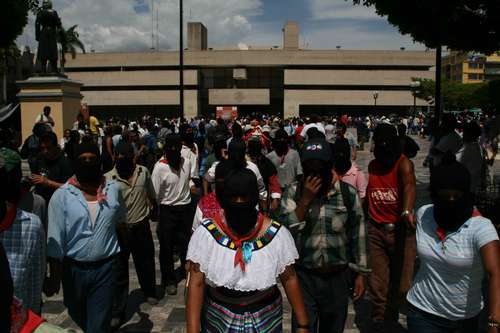
Klamath Justice Coalition Halts Logging on Karuk Sacred Sites
by Dan Bacher, Indymedia, North Coast
Wednesday Dec 16th, 2009 11:11 AM
This morning the Klamath Justice Coalition used a human blockade of 15 people to defend Karuk sacred sites from logging activities. The action took place near Orleans, CA within the Six Rivers National Forest and halted work on the Orleans Community Fuels Reduction Plan. “The OCFR is actually the Orleans Culture and Forest Reduction plan,” said Leaf Hillman, a Karuk Ceremonial Leader in Orleans. Below are the press releases from the Klamath Justice Coalition and the Karuk Tribe.
______________
PRESS RELEASE - Klamath Justice Coalition
For Immediate Release: December 16, 2009
For more information: Leaf Hillman, Karuk Indian 530-627-3710
ORLEANS RESIDENTS MOVE TO HALT FOREST SERVICE PLANS TO DESTROY SACRED SITES
Forest Supervisor Tyrone Kelly Breaks Promises and Federal Law
Orleans, CA – This morning the Klamath Justice Coalition used a human blockade to defend Karuk sacred sites from logging activities. The action took place near Orleans, CA within the Six Rivers National Forest and halted work on the Orleans Community Fuels Reduction Plan.
Forest Service contractors were greeted by activists before day break at Orleans Mountain Lookout Road which leads to one of the units in dispute. Crews turned back without involving law enforcement.
“This morning’s small but important victory marks the beginning of our campaign to defend Karuk sacred sites and protect the health of our forests,” said Orleans local Chook- Chook Hillman.
This logging operation was intended to be part of a larger fuels reduction program developed by the US Forest Service with community buy-in. However, in the end the Forest Service betrayed the local community once again.
According to the Final Environmental Impact Statement (FEIS) for the project, the stated Purpose and Need for the Orleans Community Fuel Reduction and Forest Health Project (OCFR) is to manage forest stands to reduce fuels accumulations and improve forest health around the community of Orleans, while enhancing cultural values associated with the Panamnik World Renewal Ceremonial District.
“The OCFR is actually the Orleans Culture and Forest Reduction plan,” said Hillman.
Originally, Forest Supervisor Tryone Kelly engaged with community members on a collaborative process to develop a fuels reduction plan that would protect sacred areas, reduce the risk of catastrophic wildfire, and protect sensitive stands of hardwoods. However, in practice it looks like another timber harvest that disregards the concerns of the community.
“We are shocked that the Forest Service thinks that it can get away with lying to our community. We want fuels reduction, but we will not accept the destruction of Karuk sacred sites or a timber sale disguised as a fuels reduction plan,” added Annelia Hillman.
This is not the first time that Kelly has shown a particular insensitivity to Tribal cultural issues. Last year he oversaw the bull dozing of a Tribal member’s that was on land disputed to be Indian Trust Land. The act not only destroyed a home, but destroyed a nearby archeological site and a contemporary dance ground.
Again during last years’ wildfires, Kelly directed the construction of firebreaks and use of heavy equipment that destroyed sections of “medicine man trails” and high country alters used during annual World Renewal Ceremonies. Representatives from the Karuk Tribe urged Kelley to build the breaks in areas that were less sensitive but the concerns with ignored. “Its like Kelly is hell bent to destroy our sacred areas one step at a time.” Said Hillman.
The Klamath Justice Coalition is not new to direct action as a tactic to force change. The group has staged direct actions in Scotland, Omaha, NE, Portland, OR, and Sacramento, CA, and Salt Lake City, Utah focused on the removal of Klamath Dams.
Who we are:
The Klamath Justice Coalition is an ad hoc group of Klamath Basin Residents from all walks of life. We are Indians, non-natives, mothers, fathers, workers, hippies, youth, and elders. Our goal is to ensure that the cultures and ecosystems of Klamath Communities are protected and enhanced.
# # #
Karuk Tribe
P R E S S R E L E A S E
For Immediate Release: December 16, 2009
For more information:
Craig Tucker, Spokesman, Karuk Tribe, cell 916-207-8294
US FOREST SERVICE LOGGING PROJECT THREATENS SACRED SITES
Forest Supervisor Tyrone Kelley Ignores Local Community, Tribal Leaders, and his own Proposed Plan
Orleans, CA – Six Rivers National Forest Supervisor Tyrone Kelley has directed his crews to begin logging with heavy equipment in areas sacred to the Karuk Tribe in violation of his own proposed fuels reduction plan.
“We participated in good faith in the Forest Service’s collaborative process. Although we were assured that our sacred areas would be protected and our values respected and enhanced, it’s clear now that these were hollow promises. Furthermore, the actions directed by Kelly are in violation of federal law,” said Bill Tripp, Eco-cultural Resources Specialist for the Karuk Tribe.
Over the past three years, the Orleans Ranger District in the Six Rivers National Forest has held a series of stakeholder meetings allegedly designed to work with the Orleans community to develop a fuels reduction plan that both Native and non-native community members could accept. After dozens of meetings and an appeal of Kelley’s original plan, tribal members, as well as non-native local residents, thought that a consensus had been reached. However, when logging began, community members realized immediately that Kelley had reneged on his promises and violated the law by implementing a plan inconsistent with his own Environmental Impact Statement.
At issue is the insufficient analysis related to use of heavy logging equipment in areas deemed sacred by the Karuk Tribe, divergence from measures designed to protect, promote, enhance and restore stands of ecological sensitive hardwoods, failure to protect large diameter trees[c1] , and a failure to make good on a commitment for multi-party monitoring during the fuels reduction operations.
According to the Final Environmental Impact Statement (FEIS) for the project, the stated Purpose and Need for the Orleans Community Fuel Reduction and Forest Health Project (OCFR) is to manage forest stands to reduce fuels accumulations and improve forest health around the community of Orleans, while enhancing cultural values associated with the Panamnik World Renewal Ceremonial District. Current logging operations are inconsistent with the FEIS and therefore violates the National Environmental Policy act. The Forest Service also proceeded without required consultations with the State Historic Preservation Officer (SHPO).
“The actual work on the ground will do the opposite of the stated goals. OCFR in all actuality has begun to compromise the integrity of spiritual values associated with the Panamnik World Renewal District,” said Tripp.
The areas being debated represent 914 acres to be mechanically harvested. The USFS awarded the contract to Timber Products for nearly $1 million dollars.
The Tribe is demanding that the Forest Service halt all logging operations until these issues can be resolved and sacred sites protected.
Leaf Hillman is a Karuk Ceremonial Leader in Orleans who contends that this represents the latest in a series of bad decisions by Kelley that have served to denigrate Karuk Cultural areas. According to Hillman, “Tyrone Kelley has no respect for this community or native cultures. The Tribe and local community members worked hard to develop a fuels reduction plan that meets the needs of both the community and the Forest Service. Kelley’s actions are not only an act of bad faith, they are an act of cultural genocide. We will not sit idly by while he destroys the ecological integrity of these forests and the Karuk Tribe’s sacred areas, we will defend our homeland.”
_________________________________________________________
© 2000–2010 San Francisco Bay Area Independent Media Center
Native Rights News is making this material available in accordance with Indymedia's published policy which states: "Unless otherwise stated by the author, all content is free for non-commercial reuse, reprint, and rebroadcast, on the net and elsewhere."
____________
Native Rights News (NRN) is published by the Alliance for Indigenous Rights, a nonprofit corporation owned and operated by Temple Beit Shem Tov as part of its Social Justice Ministry.
Tuesday, January 5, 2010
Human Blockade Halts Logging on Karuk Sacred Sites
Read more!


Monday, September 28, 2009
Failure of Peruvian Government to Recognize Indigenous Rights to Ancestral Lands at Heart of Recent Massacre
SOUTH AMERICA: Calls for Justice for Peru's Native Peoples
By Franz Chávez*
LA PAZ, Jun 12 (IPS) - Social organisations in South America are backing the struggle against opening up Peru’s Amazon jungle to mining and oil companies, which resulted in clashes in which at least nine indigenous people and 25 police officers died.
The recent violence near the town of Bagua, in the northern Peruvian province of Amazonas, is seen by indigenous organisations in Bolivia, Colombia and Ecuador as an attack on people who are defending life, nature, human rights and the rational use of natural resources.
Native communities in the Peruvian rainforest are demanding the repeal of a series of decrees issued by the García administration to promote foreign investment on indigenous lands, in the framework of the free trade agreement signed with the United States.
A two-month protest by indigenous people outside the northern Peruvian town of Bagua ended in bloodshed on Jun. 5, when the police violently broke up a roadblock there.
A multi-party parliamentary committee declared in December that the decrees in question are unconstitutional, as the native groups argue.
In an open letter to the region's presidents, the Confederation of Indigenous Nationalities of Ecuador (CONAIE) called on them to defend native peoples and confirm their commitment to peace and justice in South America.
A congress of the Indigenous Confederation of Indigenous People of Bolivia (CIDOB) urged the United Nations and the Organisation of American States to send a team of investigators to Bagua to verify what happened there on Jun. 5.
While official accounts say that nine indigenous people and 25 members of the police were killed, eyewitnesses who have spoken to the press say the bodies of indigenous protesters were thrown into the river from a helicopter.
"We consider this violent action by the Peruvian government to be a massacre and a flagrant violation of the life, integrity and fundamental rights of indigenous communities," said the Colombian National Authority of Indigenous Government (ONIC) in a letter to President García.
"We join our voices to the Amazonian indigenous communities who are demanding an end to the violation of their rights and the repeal of the free trade agreement decrees that open the doors to the invasion and plundering of their territories.
"We condemn the violent actions of the Peruvian government against our peoples," says the letter, which also calls for medical attention for the injured and policies to prevent a repeat of the incident.
García's response to the violence was to allege that "foreign meddling" was behind the protests in the Amazon. He later specifically mentioned Bolivia’s left-wing president, the first indigenous leader of that country.
In the midst of the political crisis triggered by the violent incident, García accused Morales of inciting the protests by means of an "inflammatory" letter sent to the Fourth Continental Summit of Indigenous Peoples, held May 29 in the Peruvian city of Puno, on the border with Bolivia.
Although he was the most important guest invited to the summit, Morales merely sent a letter by the hand of Senator Leonilda Zurita of his governing Movement to Socialism (MAS), who is an activist for women's rights and political and trade union freedoms.
The meeting, held on Peruvian soil but only 200 km west of La Paz, brought together native leaders of the Americas, called Abya Yala in precolonial times.
"That meeting discussed uprisings and insurgency," García maintained. "A president of a neighbouring country sent messages about our countries being governed by indigenous peoples, who are victims of exploitation and utterly neglected, which is not true, because the statistics on employment and welfare have improved in the jungle areas."
In La Paz, Bolivian Vice President Álvaro García Linera, a recognised champion of indigenous rights, said in reply that "letters do not kill," referring to the violence unleashed in the Peruvian Amazon.
"We confirm the contents (of the letter) and we are proud of every word and every letter in it," said the deputy minister for coordination with social movements, Sacha Llorenti, one of Morales’ closest associates.
"From resistance we have gone on to rebellion, and then to revolution. This is the second independence," said Llorenti, in support of Morales' policy of nationalising Bolivia’s abundant natural gas reserves, which were handed over by previous governments to foreign companies.
"It is difficult to rebuild what has been destroyed over 25 years of neoliberal, free market policies," Llorenti said.
Morales' letter to the indigenous leaders' summit also says "free trade agreements break up harmonious human relationships with nature; they commodify natural resources and national cultures; they privatise basic services; they try to patent life itself."
"Some people think globalisation means they have a right to interfere in the politics of neighbouring countries, "said García. "That is regrettable. If they wish, I can interfere too (in Bolivian affairs) and I know how to do so. I don't think it's democratic or legal or positive for international relations."
Sociologist Carlos Laruta, the head of the Centre for Research and Advancement of Peasant Farmers (CIPCA) in the impoverished city of El Alto, Bolivia, said that it is up to Morales to explain the intention of his letter, because he is the representative of a state and therefore subject to the rule of international law.
"A president cannot do things that run counter to international law," Laruta said.
Anthropologist Martín von Hildebrand, winner of the 1999 Alternative Nobel Prize, said the root problem is that the rights of Peruvian indigenous peoples to their ancestral territories have not been recognised in practice, as they have in other countries that share the Amazon basin: Brazil, Bolivia, Colombia and Ecuador.
"When you look at a big map of the Amazon basin, you can see that Brazil has given indigenous peoples a territory as large as Colombia itself (1.1 million square kilometres)," he said, while Colombia has given them 27 million hectares, and Bolivia and Ecuador have also made progress.
"If you look at a government map of Peru, marking potential lumber, oil, gas and mineral extraction, the country's Amazon area is completely covered with marks," said von Hildebrand, who is also head of the Gaia Amazonas Foundation, which works to strengthen indigenous culture and autonomy as a strategy for preserving the rainforest.
* With additional reporting by Constanza Vieira (Bogotá) and Ángel Páez (Lima).
__________________________________________________________
Copyright 2009: IPS-Inter Press Service
Native Rights News is making this material from [name of news source] available in accordance with the Fair Use Doctrine codified at Title 17 U.S.C. Section 107: This article is distributed without charge or profit to those who have expressed a prior interest in receiving the included information. Distribution of this material is for research and educational purposes that will promote social and economic justice and benefit society.
____________
Native Rights News (NRN) is published by the Alliance for Indigenous Rights, a nonprofit corporation owned and operated by Temple Beit Shem Tov as part of its Peace and Justice Ministry.
Read more!
Peruvian Government Massacres Indigenous Protesters Prior to Conclusion of Negotiations

For the past two months, native protesters have been blocking roads and access to oil industry installations to demand the repeal of a series of government decrees that violate their land rights, which are protected under the constitution and by international conventions signed by Peru.
"The helicopter stopped at least three times to pick up bodies," Luis Padilla, a member of the Awajun ethnic group from Río Santiago in Amazonas province, told IPS. "That was between eight and nine in the morning on Friday," added Padilla, who said it took three days to reach the town of Bagua from his village.
Padilla, who was wary of the camera, said that on Friday, Jun. 5 the police opened fire on the protesters manning the roadblock at a spot along the highway into Bagua called Curva del Diablo (Devil’s Curve), at around 6:00 AM, and that in response the indigenous demonstrators used their spears. "We defended ourselves," he said.
The police "picked up the bodies of our brothers and sisters and dumped them into the Marañón river," added Joel Tupicá, from the district of Nieva, who along with Padilla and another 24 Indians, including two women, were on their way back to their home villages on Wednesday, five days after the violent incident that left at least 30 protesters and policemen dead.
The number of victims is in dispute, with the authorities saying 10 civilians – including protesters and local residents - were killed and indigenous groups putting the total much higher.
A climate of fear and tension
Oswaldo Bautista, chief prosecutor of Amazonas province, told IPS that around 1,000 indigenous people have returned to their villages over the past few days, and that most of them had taken refuge in local churches for fear of reprisals by the state security forces.
Lawyers with the non-governmental Coordinadora de Derechos Humanos human rights group, who have come to Bagua to verify what happened last week, said more than 50 protesters are still under arrest in four different towns.
The incident, described by Amazon Watch programme coordinator Gregor MacLennan as a "massacre" of peaceful protesters, some of whom were still asleep at the roadblock when the police showed up, while others were shot as they fled, has heightened the tension in the area, because the army and police are still posted here and a curfew remains in place.
Several "apus" (traditional leaders of indigenous communities) have decided not to return to Curva del Diablo, for fear of being arrested. The authorities have blamed the violence on the leaders of the Peruvian Rainforest Inter-Ethnic Development Association (AIDESEP), an umbrella group of 28 federations of indigenous peoples that has led the protests.
AIDESEP’s top leader, Alberto Pizango, has been given asylum in the Nicaraguan Embassy in Lima.
"They burned the bodies of some protesters, over there," said Padilla, who was unable to provide the names of victims due to the chaos and confusion that reigned on Friday and the fact that the demonstrators came from more than 356 different villages and communities.
AIDESEP has set up committees in each community tasked with drawing up lists of people who have not returned to their homes, in order to demand that the state provide information on their fate.
"We want to recover the bodies of our missing people," said Edwin Montenegro, the local leader of Río Kanus in the Amazon district of Condorcanqui, who was directly involved in the Jun. 5 incident.
At the Curve of Death
Some 3,000 indigenous protesters were blocking the Fernando Belaúnde Terry highway at the Curva del Diablo when the police showed up to dismantle the roadblock early that morning and told them, just before opening fire, "you’ll leave here dead or alive," said Montenegro.
He told IPS that in the days leading up to the events of Jun. 5, protesters and local authorities had met with General Víctor Uribe, who was in charge of the operation to break up the traffic blockade, with a view to reaching a peaceful agreement.
Montenegro said a Thursday, Jun. 4 meeting with General Uribe failed to produce results. However, they had agreed to continue the talks on Friday at 10:00 AM – a meeting that never took place, because the attack on the protesters occurred four hours earlier.
The mayor of Condorcanqui, Héctor Requejo, confirmed to IPS that on Thursday they met with Uribe in the camp at the Petroperú oil refinery, and that the general said he himself could not make any decisions, but merely followed orders from Lima.
Montenegro said that when they opened fire on the crowd, the police aimed directly at the protesters, and that people were shot from a helicopter as well, which also launched tear gas canisters.
In the confusion, he was able to save his brother-in-law, prominent Aguaruna leader Santiago Manuin, president of the Condorcanqui Provincial Protest Committee (Comité de Lucha Provincial de Condorcanqui), who was seriously wounded.
Three young indigenous men who are being treated for bullet wounds at the Gustavo Lanatta Hospital in Bagua confirmed that the police launched the attack, without warning.
The three young men are all former members of the army. One of them, 24-year-old Paulo Bitap López from the village of Shusug, told IPS that a group of former soldiers decided to approach the police before the operation to break up the roadblock, to attempt to dissuade them, but that they found themselves caught up in a rain of bullets.
Rosa Mondragón, a 54-year-old woman who lives near the spot where the incident took place, said she saw tear gas being thrown from a helicopter, and showed prosecutor Bautista bullet marks on the walls of her house, as well as more than 20 backpacks and bags of utensils of indigenous protesters who slept overnight at her house for a week but fled after the attack.
The prosecutor searched gullies and ravines near the Curva del Diablo on Wednesday, after doing the same in other areas on Sunday and Monday in response to reports by local residents that bodies had been hidden there.
Bautista told IPS that no bodies were found in the latest search, only clothing and bottles of chicha, a traditional corn liquor.
Shots in the square
One of the wounded interviewed by IPS in the hospital was Daniel Torres Manay, a 55-year-old resident of Bagua who was hit in the stomach by a police bullet on Friday Jun. 5 when he was near the square where the police station is located.
Torres and his wife Amelia Delgado said the police began to shoot that day at around 11:00 AM when a group of people gathered outside the police station, after they heard that the indigenous protesters had been attacked.
According to the head of the Amazonas ombudsman’s office, Roberto Guevara, five of the nine victims acknowledged by the authorities were local residents, not indigenous people, killed by police bullets in the streets around the square.
"President Alan García committed this crime," complained Torres, who has undergone two unsuccessful operations to extract the bullet, and is waiting to be transferred to the northern city of Chiclayo for life-saving surgery.
"After we draw up a list of our brothers and sisters who were killed, we will continue our protest," said Montenegro. "The government thinks that we have chickened out, but that will never happen. The blood of their brothers and sisters is an incentive to the Awajun people. The state has provoked us. We don’t want to talk to either (Prime Minister) Yehude Simon or (Interior Minister Mercedes) Cabanillas."
Two decrees suspended
In a 57 to 47 vote Wednesday, Congress decided to suspend the implementation of two of the decrees protested by the native groups, which according to experts and legislators affect the rights of indigenous people and violate the constitution and International Labour Organisation (ILO) Convention 169 on indigenous people.
The government decrees, which are aimed at promoting foreign investment in the framework of the free trade agreement signed with the United States, open up indigenous land to private investment by oil, mining and logging companies.
Indigenous people in Peru’s Amazon jungle region, where oil companies are increasingly active, began last year to hold protests to demand that the decrees be revoked.
A multi-party legislative committee also recommended last December that they be overturned.
But AIDESEP vice president Daysi Zapata criticised the legislature’s decision to suspend the two decrees, because her organisation is demanding that they be struck down.
On Thursday, social movements held national demonstrations in solidarity with the indigenous protesters, and an indefinite strike was declared in several areas in the country’s northeastern Amazon region.
"The Amazon represents our market, our pharmacy, our home, our survival; we are defending it for the good of our people and of humanity," said Montenegro. __________________________________________________________
Copyright 2009: IPS-Inter Press Service
Native Rights News is making this material from IPS: The Story Underneath available in accordance with the Fair Use Doctrine codified at Title 17 U.S.C. Section 107: This article is distributed without charge or profit to those who have expressed a prior interest in receiving the included information. Distribution of this material is for research and educational purposes that will promote social and economic justice and benefit society.
____________
Native Rights News (NRN) is published by the Alliance for Indigenous Rights, a nonprofit corporation owned and operated by Temple Beit Shem Tov as part of its Peace and Justice Ministry.
Read more!
Tuesday, June 23, 2009
Peruvian Army Sent to Suppress Peaceful Indigenous Protests Against Resource Extraction in Amazon Basin
Amazon Watch: Oil Production Interrupted as Peru Sends in Army to Suppress Peaceful Indigenous Protests
LIMA, Peru, May 19 /PRNewswire-USNewswire/ -- The Peruvian government Saturday authorized the intervention of armed forces in the Amazon to crack down on growing indigenous protests against new decrees aimed at facilitating the entry of oil, mining, logging and agricultural companies into indigenous lands without prior consultation or consent.
On Monday, sustained protests led the state oil company, Petroperu, to shut down its main oil pipeline. This shutdown comes after a month of protests by more than 30,000 indigenous peoples. Indigenous communities have engaged in peaceful actions and blockades of roads and rivers throughout the Amazon protesting new legislation passed to facilitate the Free Trade Agreement with the USA that undermines their rights.
Videos and photos available on http://www.amazonwatch.org/ show police beating peaceful protesters and firing rubber bullets to break up peaceful Awajun and Huambis demonstrators last week when they blockaded the Corral Quemado Bridge near the northern town of Bagua, resulting in dozens injured and one person missing, who is feared dead.
In a statement, Alberto Pizango, president of the national indigenous rights organization AIDESEP who was criminally charged today for his role in the nationwide protests, stated: "The extraction of gas and oil, logging and the dredging of rivers in search of gold are destroying in a few years social structures, indigenous customs and coexistence strategies that date back thousands of years."
International and Peruvian human rights organizations are widely criticizing the Peruvian government's backward policies on indigenous peoples. In a recent statement President Alan Garcia said that every Peruvian should be entitled to benefit from the nation's natural resources, and not just a "small group of people who had the fortune to be born there."
Atossa Soltani, who heads the human rights and environmental organization Amazon Watch, commented, "Indigenous Peoples are asserting their collective right to determine how and under what conditions 'development' is carried out on their traditionally owned and legally recognized homelands."
"The Garcia Administration is clearly out of step with international conventions on indigenous rights that have been ratified by Peru, not to mention aspects of country's own Constitution. We urge the government of Peru to use restraint and avoid bloodshed, seeking meaningful dialogue to resolve the conflict instead."
__________________________________________________________
© 2000-2009 Amazon Watch
Native Rights News is making this material from Amazon Watch available in accordance with the Fair Use Doctrine codified at Title 17 U.S.C. Section 107: This article is distributed without charge or profit to those who have expressed a prior interest in receiving the included information. Distribution of this material is for research and educational purposes that will promote social and economic justice and benefit society.
____________
Native Rights News (NRN) is published by the Alliance for Indigenous Rights, a nonprofit corporation owned and operated by Temple Beit Shem Tov as part of its Peace and Justice Ministry.
Read more!
Tuesday, March 3, 2009
Indigenous Peoples Educate, Inform & Warn at Largest Climate Change Demonstration in U.S. History
 First Nation Delegates Deliver Letter to Senator Kerry in Advance of Visit from Canadian Environment Minister
More than 12,000 young people from all corners of the continent gathered in Washington, D.C. over the weekend to take part in today’s second Power Shift Conference.
The blizzard pounding the nation’s capitol apparently has not cooled the ardor of the young climate activists, who seek to change Washington’s "business as usual" attitude toward climate change and clean energy.
Various groups have scheduled more than 350 lobbying meetings with U.S. Congressmen and Senators and their staffs. An estimated 2,500 demonstrators organized by Capitol Climate Action, successfully blocked the five gates leading to the Capitol Power Plant.
Activists targeted the plant as a symbol of what is wrong with government because it burns coal and natural gas and is used to heat the Capitol’s buildings. No arrests were reported, and after four hours, the activists declared victory and raised the blockade.
Among the activists were Indigenous Peoples delegations sent by several Canadian First Nations and Native American tribes from Alaska and the "lower 48" states. One of the major purposes of the Indigenous delegations was to educate, inform and warn both the young climate activists and members of Congress about the catastrophic effects the extraction and burning of fossil fuels is having on their people and their environments.
Jessica Lee, in a post to the Indy Blog this morning reports:
"You have come here to have a voice about the environment. Our ancestors have been telling the government for 200 years to protect the environment," said Travis Brown, a student at Haskell Indian Nations University in Lawrence, Kansas, to a room of more than 175 students who attended a workshop titled, "Decolonizing Our Minds: How Colonization Affects Us Today." Brown noted that native communities across the continent are being adversely impacted not only by mineral and fuel extraction companies, but now are also suffering the effects of climate change on the landscape and eco-systems. "Our people are at the risk of being exterminated."
"Representatives from several Arctic region indigenous communities explained about how the effects of climate change — which are more extreme at the earth’s poles — including melting sea ice, eroding shorelines, thawing tundra and changes to fish, seal, whale and caribou migrations are threatening their entire way of life."
And Mike, in a post to the Environmental Age Dot Com blog, also this morning, reports:
"A delegation of Indigenous youth from Alberta went to Senator Kerry’s office outlining the devastation that is tar sands and rallied with supporters today ahead of Canad’s Environmental Minister, Jim Prentice’s visit to Capitol Hill today and tomorrow.
"They hand delivered a . . . letter express[ing] concern that Canada's Environment Minister Jim Prentice will misrepresent the disastrous environmental and human rights record of the tar sands to US Congressional leaders."
Following is the letter.
March 2, 2009
Senator John Kerry
Chairman of Foreign Relations Committee
218 Russell Bldg.
Second Floor
Washington D.C. 20510
Dear Senator Kerry,
Please allow us to present you with a different perspective on Canada’s tar sands than you are likely to hear from Canadian Minister of the Environment, Jim Prentice.
We came together this year at the Powershift gathering in Washington, DC, as members of Beaver Lake Cree Nation, Athabasca Chipewyan First Nation and Lubicon Cree Nation to share our stories with 11,000 youth from across North America. We came with messages of destruction and devastation wrought by the tar sands in our communities, but also feelings of hope that together we can contribute to building a more sustainable world for our communities and future generations. These ideas of a greener sustainable world are familiar to us as an ancient First Nations way of life.
Dangerous toxic chemicals used in the extraction of tar sands are contaminating water systems stretching all the way to the arctic basin and adversely affecting communities along the way including Athabasca Chipewyan First Nation. Expansion of the tar sands is a direct attack on who we are as a people. Many First Nation peoples believe in the medicine wheel with four elements: earth, water, air and fire—three are polluted by these projects. Destroying these elements destroys who we are. The tar sands are killing us.
Beaver Lake Cree Nation is also being encroached upon by rapidly expanding tar sands infrastructure and development. Natural gas wells used to power oil production in the tar sands are almost literally in the community’s backyards. Pollution from these projects adversely affecting peoples’ health, way of life and violate established treaty rights. Animals are dying, disappearing, and being mutated by the poisons dumped into our river systems. If there is no fish, we cannot fish, if there is no more game, we cannot hunt. Our traditional lands and water houses our culture. They are one and the same. Once we have destroyed these fragile eco-systems we will have also destroyed our peoples and trampled our treaty rights.
Construction of the Transcanada North Central Corridor pipeline, set to cross through the traditional territory of Lubicon Lake First Nation without the consent of the community is an outright violation of human rights and inherent rights of the community as Indigenous peoples. With oil and logging already impacting this territory, expansion of oil infrastructure will continue to wreck havoc on the land and displace even more wildlife.
Our communities are looking for energy solutions that provide a healthy sustainable community for our future generations. The sustainable future for First Nations in Alberta, Canada and the United States of America alike, cannot be achieved by further exploiting one of the dirtiest, most energy intensive and destructive sources of oil on the planet. It's time we focus our efforts on building a clean sustainable future that puts our people to work in a safe, green energy economy.
Senator Kerry, we urge your leadership in the Congress to:
Respect and recognize established treaty rights during the Clean Energy Dialogue: These discussions will surely frame the future of energy in our countries. They will also determine the whether culturally significant and bio-diverse regions of our respective countries, as well as the livelihoods of the Indigenous peoples that inhabit this turtle island, are preserved.
Focus the Clean Energy Dialogue on renewable energy and energy efficiency: The main focus of the dialogue should be on clean energy efforts and include wind, solar, and other renewable fuels and on transportation solutions such as electrified transportation and high speed rail.
Sincerely,
Melina Laboucan-Massimo, Lubicon Cree Nation
Gitz Crazyboy, Athabasca Chipewyan First Nation
Myron Lameman, Beaver Lake Cree Nation
cc:
Minister Jim Prentice
Secretary Steven Chu
Secretary Kenneth Salazar
Secretary Hillary Rodham Clinton
EPA Administrator Lisa Jackson
CEQ Chair Nancy Sutley
__________________________________________________________
News Sources: Environment News Service, The Indypendent, The Environmental Age Dot Com
Native Rights News is making this material from the news oganizations and blogs listed above available in accordance with the Fair Use Doctrine codified at Title 17 U.S.C. Section 107: This article is distributed without charge or profit to those who have expressed a prior interest in receiving the included information. Distribution of this material is for research and educational purposes that will promote social and economic justice and benefit society.
Read more!
Wednesday, February 25, 2009
Residential School Survivors Occupy Vancouver Church
 International Media Statement, For Immediate Release
The Friends and Relatives of the Disappeared (Vancouver)
The protestors entered the church sanctuary as the worship service commenced and unfurled a banner declaring "All The Children Need A Proper Burial". After leafletting the congregation and making a statement, the protestors left, vowing to return if the United Church did not surrender the remains of native children who died under their care and halt further destruction of their burial sites.
The occupation was prompted by the partial destruction this week of the last building of the United Church's former Alberni Indian residential school, where eyewitnesses claim that the remains of former students are buried.
"They're destroying the evidence of their crime, and under the law, that's a crime" said Bingo, a survivor of the Alert Bay residential school. "We're not listening to their bullshit anymore. We'll be back with more people next time."
Squamish hereditary Chief Kiapilano, who legally evicted the United Church from his territory last March, endorsed the occupation and called for similar actions by other residential school survivors. These occupations of United Churches during their Sunday services will continue and will escalate until the fallen children are brought home, their killers are brought to justice, and the residential school crime sites are all protected.
Issued by The Friends and Relatives of the Disappeared (Vancouver)
Read and Hear the truth of Genocide in Canada, past and present, at thiswebsite: http://www.blogger.com/www.hiddenfromhistory.org
"Kevin [Annett] is more deserving of the Nobel Peace Prize than many who have received it in the past."- Dr. Noam Chomsky, Institute Professor Emeritus, Massachusetts Institute of Technology
"A courageous and inspiring man." (referring to Kevin Annett)- Mairead Corrigan-Maguire, Nobel Peace Prize Laureate, Belfast, Northern Ireland"
The very lands we all along enjoyed
- Daniel Defoe, Jure Divino (England, 1706) From: Eagle Strong Voice
Native Rights News is making this material available as the result of a press release issued by The Friends and Relatives of the Disappeared (Vancouver). We are publishing the image from http://www.hiddenfromhistory.org in accordance with the Fair Use Doctrine codified at Title 17 U.S.C. Section 107: This article is distributed without charge or profit to those who have expressed a prior interest in receiving the included information. Distribution of this material is for research and educational purposes that will promote social and economic justice and benefit society.
Read more!
Tuesday, February 17, 2009
NWT High Court Denies Aboriginal Land Claims and Upholds NT Intervention Program
Originally published in WAtoday.com.au (02-02-09)
 Protesters stormed inside the High Court and clashed with police after the court dismissed a challenge against the federal intervention into Northern Territory Aboriginal communities.
Dozens of anti-intervention protesters, both indigenous and non-indigenous, pushed through the court's front doors minutes after it rejected the case brought by traditional owners from the Arnhem Land community of Maningrida.
Carrying banners and clapping, the protesters chanted, "Always was, always will be Aboriginal land," as they moved into the court's main foyer.
Security guards tried to prevent the protesters from entering the building but were quickly overwhelmed.
Police appeared on the scene soon after, triggering scuffles as they tried to force the protesters back outside.
After a tense half-hour stand-off, the protesters took their demonstration to the streets of Canberra.
Under the NT intervention program, launched by the Howard government in a bid to tackle child sexual abuse, the commonwealth took control of township leases, abolished the permit system, introduced welfare restrictions, boosted police numbers and imposed alcohol and pornography bans.
Maningrida traditional owners Reggie Wurridjal and Joy Garlbin took on the commonwealth over its compulsory five-year takeover of their land.
The land, measuring 10.456 square kilometres, includes a township, four sacred sites, an outstation, a sand quarry, a billabong and a ceremonial site.
The elders, along with the Bawinanga Aboriginal Corporation, argued the commonwealth failed to acquire the land on "just terms" as required by the constitution.
But the court, by a six to one majority, rejected their argument, saying the laws underpinning the intervention properly provided for compensation for Aboriginal organisations and people.
Retiring Justice Michael Kirby, in his final judgment in the court, dissented, arguing the case should be sent to trial.
"The law of Australia owes the Aboriginal claimants nothing less," he said.
A majority of justices also overruled a 1969 High Court decision which held that the just terms requirement in section 51 of the constitution did not apply to laws made by the commonwealth for the governing of the NT and ACT.
__________________________________________________________
Copyright © 2009. Fairfax Digital
Native Rights News is making this material from WAtoday.com.au available in accordance with the Fair Use Doctrine codified at Title 17 U.S.C. Section 107: This article is distributed without charge or profit to those who have expressed a prior interest in receiving the included information. Distribution of this material is for research and educational purposes that will promote social and economic justice and benefit society.
--
Posted By Perry Chesnut, Editor to Native Rights News at 2/03/2009 06:52:00 AM
Read more!
Western Shoshone Call for Peaceful Demonstrations Outside of Federal Court in Reno

Great Basin Research Watch
85 Keystone Ave., Suite K
Reno, NV 89503
775-348-1986
www.gbrw.org
For Immediate Release January 16, 2009
Contact: Julie Cavanaugh-Bill (775-397-6726), wsdp@igc.org
Dan Randolph (775-348-1986), dan@gbrw.org
Demonstration and News Conference to Protect Native Religions
Where: Gordon R. Thompson Federal Bldg. (S. Virginia and Liberty)
When: Tuesday, January 20, 8:00 AM
On this day of the inauguration of a new president with hope for the future we are reminded that the founding fathers of the United States dedicated into our constitution freedom to practice religion as ones tradition required.
Just two months ago, the U.S. Bureau of Land Management approved the construction of a massive open pit cyanide heap leach gold mine on the face of well-known spiritual area, Mt. Tenabo. Western Shoshone communities, the Western Shoshone Defense Project and Great Basin Resource Watch are seeking an injunction to stop further destruction of Mt. Tenabo by Barrick Gold Corporation. The Federal Court in Reno has scheduled a hearing on Jan. 20th and 21st.
The peaceful and respectful demonstration will open with native drumming, song, and prayer. Western Shoshone elders will speak, and supporting local religious leaders will follow. Just before 9:00 AM the demonstration will close and all supporters will be invited to attend as much of the injunctive hearing as they can in support of religious freedom. There will also be a similar demonstration at the same time on January 21.
"Denabo (correct pronunciation) has special significance for Western Shoshone, it means the writing on the rocks walls of the mountain (White Cliffs) put there by our Creator. We go to pray to our Creator to give us strength to keep us going. How can we pray to our creator when the place is being blown up?" - Joyce McDade, Western Shoshone Grandmother.
"When God makes a covenant to provide for human beings, the covenant always includes the land. Our well-being as a species is conditioned upon our capacity to love and care for the land. Native American communities and their spiritual practices have enlightened our way to this love and care."– John Auer, Reverend First United Methodist Church, Reno NV.
Barrick Gold Corporation is the world's largest gold company and operates mainly on Indigenous lands for the extraction of gold. This company has refused to accept its social responsibility to protect Indigenous peoples' land, sacred areas, water, and air pollution.
--
Posted By Alliance for Indigenous Rights to Native Rights News at 1/19/2009 08:24:00 AM
Read more!
Tuesday, January 13, 2009
Conflict Over Mining Deepens Between Correa Government and Indigenous Peoples and Environmentalists
| Ecuador Anti-Mining Blockades Met With Repression, National Mobilization Called for January 20 |  |  |
| Written by Daniel Denvir, Photographs by Ximena Warnaars | |
| Friday, 09 January 2009 | |
|
The government of President Rafael Correa has assumed an aggressive posture, insulting indigenous and environmental activists and pledging to secure approval for a controversial new Mining Law. Canadian companies hold the majority of mining concessions in Ecuador and are pressing for a new law that would allow for large-scale, open pit metal mining.
Protesters also argue that the law contradicts important provisions of the new constitution protecting water, the environment and indigenous peoples’ rights. The document drew international attention for awarding legal rights to nature. The new constitution, approved by popular referendum in September, is the centerpiece of Correa’s first term. After emergency meetings on January 7, the Confederation of Indigenous Nationalities of Ecuador (CONAIE) called for a national mobilization on January 20, calling the government “dictatorial.” It is unclear whether the January 20 mobilization will spread road blockades to other provinces in central and northern Ecuador. Protesters are demanding a dialogue with central government leaders and for a broad national discussion on mining before any legislation is passed. Some protesters in the Southern provinces of Zamora Chinchipe and Morona Santiago suspended their blockades for 24 hours in response to the provincial governor’s promise to reach out to Francisco Cordero, the President of the Congresillo, Ecuador’s interim legislature. Other blockades were suspended in anticipation of the nationwide actions. The blockades began on Monday January 5 in the Southern province of Azuay, cutting off much of the traffic into and out of Cuenca, Ecuador’s third largest city. Over the next few days, the protests spread to the neighboring Andean province of Loja and to the Amazonian provinces of Zamora Chinchipe and Morona Santiago.
On January 6, campesino leader Vicente Zhunio Samaniego was arrested in the Southern province of Morona Santiago, showing up 16 hours later in a hospital with bullet wounds to the head. On January 7, protest leader Miguel Ángel Criollo and his son Orlando were arrested in an early morning raid on the village of Pueblo Nuevo in Azuay province. The newspaper El Universo reports that over fifty police officers from the Special Operations Group (GOE) took part in the raid. When villagers tried to defend the Criollos from arrest, police fired tear gas, forcing the evacuation of a local school. In the city of Cuenca, police violently repressed protests at the Court of Justice. As six leaders began a hunger strike inside the building, the police attacked a press conference taking place outside the building, arresting Water Board leader Carlos Pérez Guartambel. Police used tear gas to disperse protesters attempting to defend Pérez. Police then forced hunger strikers and four women supporting them out of the Court building, dragging them by their necks. The governor of Azuay denied that Pérez was arrested, and he was freed later that day. The six hunger strikers are now in Cuenca’s San Roque Church. According to the newspaper El Comercio, Minister of Mines and Petroleum Derlis Palacios said that the government would push forward with the Mining Law. Palacios said that Ecuador “was a poor country that could not afford to just sit on these large resources.” He added that protests were the result of manipulation by indigenous leaders who mislead community members by claiming that mining would harm their access to clean water. Palacios said that the new law would ensure that water sources are protected. Congresillo President Cordero told El Comercio that protesters were using the demonstrations to advance electoral ambitions. The CONAIE condemned the government’s description of protesters as “criminals and subversive terrorists,” saying that “the only thing we are fighting for is life and dignity for all of Ecuador’s citizens.” The CONAIE that such comments are aimed “to stigmatize [protesters] and prepare public opinion for even more severe repression.” Correa is coming into increasing conflict with social and indigenous movement activists. On Thursday January 8, the United Labor Front (FUT), Ecuador’s largest labor federation, announced mass protests for a higher minimum wage increase for January 15. They say that Correa’s proposed increase of $18 a month, to $218, is a step back and fails to meet provisions in the new constitution ensuring that all Ecuadorians are paid a living wage. Ximena Warnaars is an anthropologist and PhD student from the University of Manchester, UK living in Cuenca, Ecuador. Daniel Denvir is a Quito, Ecuador based journalist in the process of moving to Philadelphia, and a 2008 recipient of NACLA's Samuel Chavkin Investigative Journalism Grant. He is an editor at www.caterwaulqu |
 The ongoing conflict over mining in Ecuador escalated this week as blockades shut down highways throughout the country’s Southern Andean highlands and Amazon rainforest, while nationwide protests have been called for January 20.
 A number of leaders have been arrested and other protesters were beaten and shot at by police. Campesino and indigenous protesters, who depend on clean water to farm and for drinking water, are demanding that the government shelve President Rafael Correa’s proposed Mining Law, saying that it would be a social and environmental disaster. The rural blockades follow months of regular protests in Quito and other parts of the country
 In Giron, Molleturo, Tarqui (Azuay), Limon Indanza (Morona Santiago) and in El Pangui (Zamora Chinchipe) protestors have been beaten or shot by police. Police officials and journalists were released after being briefly detained by campesinos.
__________________________________________________________
© 2009 Upside Down World
Native Rights News is making this material from Upside Down World available in accordance with the Fair Use Doctrine codified at Title 17 U.S.C. Section 107: This article is distributed without charge or profit to those who have expressed a prior interest in receiving the included information. Distribution of this material is for research and educational purposes that will promote social and economic justice and benefit society.
Read more!
Monday, January 12, 2009
Ecuadorian Government Debates Law Favoring Canadian Mining Companies over Constitutional Rights of Nature and Indigenous Tribes

By Daniel Denvir, Today correspondent
The Mining Law, currently under debate in the provisional National Assembly, or Congresillo, would replace the Mining Mandate passed in May of this year. The Mandate froze mining operations and revoked a number of concessions to foreign corporations. The law would create a National Mining Company and increase state control over foreign corporations, which are largely Canadian. But the law would also allow mining to take place anywhere, including in protected areas and sharply limit community input.
In Quito, buses arrived from throughout the country to protest the mining law. Marching to the National Assembly, protesters clashed with police, who used pepper spray to push back activists intent on meeting with legislators. A small delegation was allowed to enter in the afternoon. The protests were organized by the Confederation of Indigenous Nationalities of Ecuador (CONAIE) and the Coordinator for the Unity of the Left and for Life, a new organization dedicated to regrouping social movements to confront Correa.
The march is possibly a prelude to a nation-wide uprising. While the protest was not large by Ecuadorian standards, representatives from many communities were present. Earlier this month, more than 30 organizations gathered in the Amazonian city of Coca and agreed to oppose Correa’s business friendly policies. Former Correa spokesperson and Assembly Member Monica Chuji said, “Today is a first step in a broader process of unifying social movements. Today we don’t have quantity, but we have unity.” Chuji, an Amazonian Kichwa, broke with Correa’s Alianza País Party in September, accusing the president of opposing indigenous rights.
Correa insists that responsible mining is necessary for Ecuador’s development. In November, Correa accused the indigenous movement of “losing their compass and playing into the hands of sectors that they have historically criticized, such as the Right, which the current administration is combating.” Correa has threatened to send the Mining Law to a national referendum if the indigenous movement alters it or blocks its approval, accusing the CONAIE of being anti-democratic.
But Dr. Byron Real López, an expert in environmental law, wrote in a recent report that the Mandate “is concerned with solving important issues. ... such as the corruption surrounding the indiscriminate granting of concessions. But the proposed law ignores the ecological and social conflicts that mining activity causes. ... and thus would tend to aggravate them.” López argues that the proposed law would violate a number of provisions in the new constitution, such as those protecting the rights of nature and indigenous communities.
Juan Francisco, a young Kichwa, traveled from the Southern province of Cañar. “We will never let them into our territory, which provides our water. Responsible mining is a miserable lie that the government wants to sell to us.” Juan Francisco said that the government should instead support sustainable and organic farming.
“We oppose the Mining Law because we love nature. Mining will kill us, it will poison the water with chemicals. We all drink this water and we all will die. Water doesn’t belong to anyone. It belongs to us all.”
Despite Correa’s dismissive comments, it appears that the government is taking the movement seriously. Two days after the protests Ecuador’s interim legislature, the Congresillo, announced that they were considering extending discussion on the law by seven days – potentially pushing back a vote until Jan. 12. On Dec. 26, Congresillo President Francisco Cordero began a series of meetings with social movement leaders opposed to the project. The stated objective is to incorporate critics’ perspectives before the proposal undergoes a second debate, the last step before a vote.
But the CONAIE demands that the law be shelved so that a national debate on mining can take place. And protesters were adamant in their opposition to large-scale mining.
Carmen, a Saraguro Kichwa woman from the Southern province of Loja, said, “We oppose the Mining Law because we love nature. Mining will kill us, it will poison the water with chemicals. We all drink this water and we all will die. Water doesn’t belong to anyone. It belongs to us all.”
Campesino Jorge Marin traveled hours by bus from the Southern Amazonian province of Morona Santiago. “We’re here to stop the Mining Law, a law that will make it impossible for us to be owners of our land. We are here to defend nature and let the Congress know that we depend on the Amazon for life.”
Leaders of the CONAIE were scheduled to meet in a special assembly the first week of January to discuss a possible national uprising.
Salvador Quishpe, a Kichwa leader from the Southern Amazonian province of Zamora Chinchipe, told the crowd that mass mobilization would be necessary to stop the Mining Law. “If we have to celebrate Christmas in the streets to stop this law, we will!” Quishpe said that while it was impossible to bring thousands of people from Zamora Chinchipe to Quito, 1,500 delegates met in his province earlier this month and declared their support for nation-wide mass mobilizations.
© 1998 - 2009 Indian Country Today
Native Rights News has adapted and is making this material from Indian Country Today available in accordance with the Fair Use Doctrine codified at Title 17 U.S.C. Section 107: This article is distributed without charge or profit to those who have expressed a prior interest in receiving the included information. Distribution of this material is for research and educational purposes that will promote social and economic justice and benefit society.
Read more!
Tuesday, December 16, 2008
Mexican Development Plans Threaten Land and People of Chiapas
IntercontinentalCry.org
December 12, 2008
Threatening the Land and People of Chiapas
by Ahni (John Schertow) The Mexican government has announced plans to bring ‘progress’ and ‘development’ to Chiapas, under the renewed “Plan Puebla Panama” scheme, now called the “Mesoamerica Initiative.”
“A renewed push to exploit and destroy the land and people of Chiapas,” says rootforce, the plan involves the ‘four horsemen of Chiapas’: mining, infrastructure, bio-fuel, and oil.
For some time now Chiapas has been faced with major challenges surrounding minerals exploitation, particularly from Canadian mining companies, who, as we should all know well by now, “are notorious throughout Latin America [and the rest of the world] for their ruthless eviction of traditional communities and for their devastation and pollution of lands and rivers,” says Jessica Davies.
This is precisely what awaits Chiapas where “there are apparently 55 new mining applications pending… for the exploration and extraction until 2056 of gold, silver, copper, barite, lead, titanium, iron, zinc, antimony, molybdenum, and other minerals needed for the oil industry,” Davies adds.
Regarding infrastructure, the government wants to help the extractive industry and expand tourism by constructing roads, bridges, and various other developments.
For instance, in the Northern part of Chiapas, a so-called “eco-archaeological tourism” theme park is currently in the works.
Located at the pre-colonial Mayan city of Palenque, the ‘them park’ will consist of “[a highway and 3 bridges] as well as hotels, restaurants, related businesses and an expansion of the Palenque Airport,” according to the Chiapas Support Comittee. “The highway and other construction will cut through and divide the land of the living Maya while facilitating the tourist exploitation of [their ancestors].”
Plans for the final two ‘horseman’ - oil and bio-fuel - were announced by the Mexican Energy Secretary Georgina Kessel, on November 21.
Kessel said that in 2009, Pemex, Mexico’s state-owned oil company, would be allowed to start prospecting and drilling for oil in the Lacandon rain forest, among other areas.
Kessel further announced a plan to produce bio-diesel in Chiapas, using a plant called “Jatropha curcus.”
Also known as the “Black Vomit Nut” Jatropha is a very controversial plant because of its highly toxic properties. Consuming as few as three of its seeds can be fatal to humans.
Overall, this four-part scheme, which has been pledged to “save the economy” and bring “progress and development for the benefit everyone,” implies “very serious threats to the rich biodiversity of the state of Chiapas and to the rights and the lands of the indigenous peoples of the region,” states the NGO ‘Maderas del Pueblo’ in a November 23 communique.
With it, “the federal and state governments have shown that they have embarked on a ’schizophrenic demagogy’ in which, at the same time as they announce policies, programmes and ‘green’ resources to tackle climate change, there is an obvious contradiction as they are clearly demonstrating themselves in favour of a return to a savage capitalism, of a short-term and extractive character, together with the interests of grand capital, of the biotechnology and pharmaceutical sectors, of those producing bottled water and all those keen to convert wood and forest cover into ’sinks’” for the multinational carbon market; of all those hiding behind a disguise of green philanthropy and supported by cross-governmental, national and international organisations, and calling themselves ‘conservationists’, and who have been encouraging and applauding the official policy of pillaging and plundering the biodiverse indigenous territories and turning them into ‘Protected Natural Areas’ ‘for the benefit of humanity’,” Maderas del Pueblo continues.
“The basic question [now] is: Will the indigenous people and campesino communities, with their lands, natural resources and rights all threatened, permit this proposed plunder to take place?”
photo:redamazon.wordpress.com
__________________________________________________________
Article originally published by intercontinentalcry.org
Native Rights News is republishing this article under the terms of a Creative Commons Attribution-Noncommercial-Share Alike 2.5 Canada License.
Read more!
Tuesday, December 2, 2008
Canada Ignores Pleas of Native Leaders, Adds to Poverty and Homelessness of Native Peoples in Preparation for 2010 Olympic Games
CANADA: Native Rights Concerns Cloud 2010 Games
By Jon Elmer
VANCOUVER, Dec 1 (IPS) - A coalition of indigenous elders, social justice activists and community organisers is voicing opposition to the upcoming Winter Olympics, promising to continue their protests up to and throughout the 2010 games.
Taking advantage of a three-day media briefing hosted by the official Olympic body in late November, the Vancouver Organising Committee (VANOC), activists and native representatives invited the local and visiting international media to an office in the heart of the what is commonly known as Canada's poorest neighbourhood, the Downtown Eastside, to hear "the other side of the Olympic story".
Rallying under the banner of "No Olympics on stolen native land", speakers representing nine native and community groups outlined connections between native poverty, dislocation and homelessness and the staging of the games in Vancouver and Whistler, 120 kms north of Vancouver.
Arthur Manuel, a former chief in the Neskonlith Indian Band of the Secwepemc nation, accused the Canadian government of attempting to whitewash the structural violations of native sovereignty. "We are the poorest people in the country," Manuel said. "Not because this country is poor, but because [the government] continues to violate the human rights of the indigenous people, by not recognising our Aboriginal title and our treaty rights."
Nearly all of the province of British Columbia -- including the land on which the Vancouver-Whistler Olympics will be staged -- is not subject to any treaty and the land has not been otherwise ceded or surrendered by its indigenous inhabitants, as Canada's highest court has recognised.
Manuel cited Canada's refusal to sign on to the United Nations Declaration on the Rights of Indigenous Peoples as evidence that the government does not intend to follow the principles of international law in dealing with native sovereignty. In September 2007, the U.N. declaration was passed 143 to four, with the United States, Australia and New Zealand joining Canada in opposition.
James Louie, a member of the St'at'imc nation whose traditional lands encompass the rapidly expanding Whistler mountain and resort, said the expansion of infrastructure and development for the Olympics undermines the status of his people's case before the Organisation of American States treaty process.
"Because we have no treaty with Canada, the imposition and encroachment of Whistler -- their hydro lines, their highways, their railroad, you name it, anything they do with our territory -- is illegal," Louie said.
The Olympics have spurred a construction and development boom in Vancouver and Whistler in particular, and in British Columbia in general. Between July and September 2007, 843 major capital projects were planned or underway throughout British Columbia, valued at U.S. 108 billion dollars, according to the provincial government's ministry of economic development.
A VANOC budget report last year pegged the operating costs for the games at 1.32 billion dollars. The provincial and federal governments have provided an additional 468 million dollars, primarily for venue construction, including ski hill development in St'at'imc territory. The official Olympics budget does not include major infrastructural projects undertaken by the government in preparation for the February 2010 games, including the 484-million-dollar expansion of the Vancouver-to-Whistler highway.
Seislom, a Lil'wat elder who is also known as Glen Williams, addressed the legacy of the expansion around Whistler and its impact on the environment. "When my grandfather took me up Whistler mountain, the land was pure. Now it's polluted, it's desecrated. I ask myself the question: what will my grandchildren get from all of this?"
According to VANOC, 20.5 million dollars in venue construction and 95,163 dollars in non-venue contracts have been awarded to Aboriginal businesses through an incorporated native society called the Four Host First Nations Society (FHFN).
Several speakers challenged the role of FHFN in their communities. Seislom said the FHFN "choose not to recognise traditional, hereditary chieftainships" and instead only "recognise their own chieftainships in terms of corporate development, in terms of the Department of Indian Affairs, in terms of anything to do with money and power."
Dustin Johnson, a Tsimshian activist and organiser, also questioned the legitimacy of the FHFN. "It is important to make a distinction between elected leaders under the Canadian Indian Act system and the traditional governments, the traditional leaders," he said.
Canada imposed the Indian reserve and band council system through Indian Act of 1876, nine years after the country was founded. It wasn't until 1953 that the Act was amended to allow natives to organise around a land claim, which had previously been illegal.
Johnson characterised the Four Host First Nation Society as a small group of "elite native capitalists who don't represent the majority of native people".
"They'll paint the picture that they are trying to create economic development and self sufficiency, but it's really twisting the logic of what our people stand for: a lot of our people stand for sustainable development and protecting what little we have left of our lands and resources," Johnson said.
Arthur Manuel criticised the government and the FHFN for spending millions showcasing native arts and culture while ignoring the structural causes of the poverty. "They are using that money for the purpose of disguising the violations of human rights of the indigenous people of this country."
The BC Child and Youth Advocacy Coalition last week issued a report that showed BC for the fifth-straight year has the highest rate of child poverty in Canada, at almost 22 percent. The rate for native children is 40 percent but, the report notes, "the number would be significantly higher if the data had included children living on reserve." Recent statistics from the Canadian government's Department of Indian and Northern Affairs put the number of natives in BC at 122,000; about half live on reserves.
In Vancouver, the largest urban centre to host a Winter Olympics, there is likely as many as 8,000 homeless people, according to researchers at Simon Fraser University's Centre for Applied Research in Mental Health and Addiction, a disproportionate number of whom are native.
The rates of child poverty and homelessness continue to increase.
Laura Track, a lawyer with the Downtown Eastside's Pivot Legal Society, said that over 1,400 units of affordable housing have been lost since Vancouver was awarded the games in July 2003. Hundreds of tenants have been evicted from single-room occupancy hotels in the Downtown Eastside, as the Olympic-borne real estate development boom has deepened the homelessness crisis.
Outgoing Vancouver mayor Sam Sullivan, who presided over a sharp increase in homelessness during his tenure, has called the crisis "a civic, and provincial and national shame."
Vancouver is anticipating as many as two million visitors during the XXI Winter Olympic Games to be held from Feb. 12-28, 2010. According to VANOC spokesperson Suzanne Walters, more than 10,000 members of the media are expected for the games, including 2,900 print and photo-journalists.
http://www.ipsnews.net/news.asp?idnews=44930
Native Rights News is making this Inter Press Service News Agency material available in accordance with the Fair Use Doctrine codified at Title 17 U.S.C. Section 107: This article is distributed without charge or profit to those who have expressed a prior interest in receiving the included information. Distribution of this material is for research and educational purposes that will promote social and economic justice and benefit society.
Read more!