IntercontinentalCry.org
December 12, 2008
Threatening the Land and People of Chiapas
by Ahni (John Schertow) The Mexican government has announced plans to bring ‘progress’ and ‘development’ to Chiapas, under the renewed “Plan Puebla Panama” scheme, now called the “Mesoamerica Initiative.”
“A renewed push to exploit and destroy the land and people of Chiapas,” says rootforce, the plan involves the ‘four horsemen of Chiapas’: mining, infrastructure, bio-fuel, and oil.
For some time now Chiapas has been faced with major challenges surrounding minerals exploitation, particularly from Canadian mining companies, who, as we should all know well by now, “are notorious throughout Latin America [and the rest of the world] for their ruthless eviction of traditional communities and for their devastation and pollution of lands and rivers,” says Jessica Davies.
This is precisely what awaits Chiapas where “there are apparently 55 new mining applications pending… for the exploration and extraction until 2056 of gold, silver, copper, barite, lead, titanium, iron, zinc, antimony, molybdenum, and other minerals needed for the oil industry,” Davies adds.
Regarding infrastructure, the government wants to help the extractive industry and expand tourism by constructing roads, bridges, and various other developments.
For instance, in the Northern part of Chiapas, a so-called “eco-archaeological tourism” theme park is currently in the works.
Located at the pre-colonial Mayan city of Palenque, the ‘them park’ will consist of “[a highway and 3 bridges] as well as hotels, restaurants, related businesses and an expansion of the Palenque Airport,” according to the Chiapas Support Comittee. “The highway and other construction will cut through and divide the land of the living Maya while facilitating the tourist exploitation of [their ancestors].”
Plans for the final two ‘horseman’ - oil and bio-fuel - were announced by the Mexican Energy Secretary Georgina Kessel, on November 21.
Kessel said that in 2009, Pemex, Mexico’s state-owned oil company, would be allowed to start prospecting and drilling for oil in the Lacandon rain forest, among other areas.
Kessel further announced a plan to produce bio-diesel in Chiapas, using a plant called “Jatropha curcus.”
Also known as the “Black Vomit Nut” Jatropha is a very controversial plant because of its highly toxic properties. Consuming as few as three of its seeds can be fatal to humans.
Overall, this four-part scheme, which has been pledged to “save the economy” and bring “progress and development for the benefit everyone,” implies “very serious threats to the rich biodiversity of the state of Chiapas and to the rights and the lands of the indigenous peoples of the region,” states the NGO ‘Maderas del Pueblo’ in a November 23 communique.
With it, “the federal and state governments have shown that they have embarked on a ’schizophrenic demagogy’ in which, at the same time as they announce policies, programmes and ‘green’ resources to tackle climate change, there is an obvious contradiction as they are clearly demonstrating themselves in favour of a return to a savage capitalism, of a short-term and extractive character, together with the interests of grand capital, of the biotechnology and pharmaceutical sectors, of those producing bottled water and all those keen to convert wood and forest cover into ’sinks’” for the multinational carbon market; of all those hiding behind a disguise of green philanthropy and supported by cross-governmental, national and international organisations, and calling themselves ‘conservationists’, and who have been encouraging and applauding the official policy of pillaging and plundering the biodiverse indigenous territories and turning them into ‘Protected Natural Areas’ ‘for the benefit of humanity’,” Maderas del Pueblo continues.
“The basic question [now] is: Will the indigenous people and campesino communities, with their lands, natural resources and rights all threatened, permit this proposed plunder to take place?”
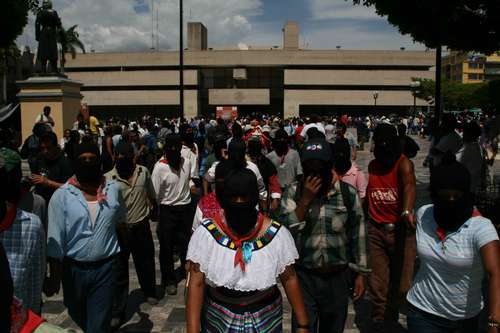
photo:redamazon.wordpress.com
__________________________________________________________
Article originally published by intercontinentalcry.org
Native Rights News is republishing this article under the terms of a Creative Commons Attribution-Noncommercial-Share Alike 2.5 Canada License.
Tuesday, December 16, 2008
Mexican Development Plans Threaten Land and People of Chiapas
Read more!


Monday, December 15, 2008
Huge Land Rights Victory for Brazilian Indians
Indians rejoice as Supreme Court affirms land rights
Survival International
11 December 2008 Indians across Brazil are celebrating today as the majority of judges in the Supreme Court ruled to uphold indigenous land rights in a key case. Indian representatives have called the decision, made yesterday on the 60th anniversary of the Universal Declaration of Human Rights, a ‘great victory’.
The ruling concerns the indigenous territory Raposa-Serra do Sol (‘Land of the Fox and Mountain of the Sun’) in the Amazon state of Roraima. A small group of powerful farmers, who want the Indians’ land and are supported by local politicians, had petitioned the Supreme Court to overturn the Brazilian government’s legal recognition of the territory. President Lula signed the territory into law in 2005.
Yesterday eight out of eleven Supreme Court judges affirmed the Indians’ rights to the land, saying it had been demarcated according to the constitution. They affirmed the importance of maintaining indigenous territories as single, continuous areas and stated that territories on Brazil’s borders do not pose a risk to national sovereignty.
The five tribes of Raposa-Serra do Sol had struggled for thirty years to reclaim their ancestral land. The group of farmers refused to leave the area when it was demarcated as an indigenous territory, and since the demarcation they have been waging a campaign of violence against the Indians in order to resist being removed from the land.
Shocking footage taken in May this year shows gunmen hired by one of the farmers attacking a Makuxi Indian community, throwing homemade bombs and firing assault rifles. Ten Indians were wounded in the attack.
The judges also ruled that the farmers must leave Raposa-Serra do Sol, but did not specify when. This will be decided when the ruling is concluded during the court’s next session starting in February 2009, when the remaining three judges deliver their rulings.
Makuxi leader Jacir José de Souza of the Indigenous Council of Roraima (CIR) said today, ‘The land is our mother. We are happy that [our land] has been reclaimed and that the Supreme Court has vindicated indigenous people.’
The Indians of Raposa-Serra do Sol believe that the loss of their land would have destroyed their way of life. Indians elsewhere in Brazil also feared that if the Supreme Court had overturned the demarcation of the territory, it would have left their lands open to similar legal challenges.
Survival’s director Stephen Corry said today, ‘This is fantastic news for the people of Raposa-Serra do Sol. The Brazilian government must now make sure that the farmers leave the area and that the campaign of terror against the Indians ends. It must also ensure that Indian land rights are upheld nationwide, so that never again will we see such blatant attacks on Indians on their own land.’
For more information please contact Miriam Ross at Survival International (+44) (0)20 7687 8734 or (+44) (0)7504 543 367 or email mr@survival-international.org
Act now to help the Indians of Raposa–Serra do Sol
Your support is vital if the Indians of Raposa Serra do Sol are to survive. There are many ways you can help.
Donate to the campaign for the Indians of Raposa Serra do Sol (and other Survival campaigns).
Write to your MP or MEP (UK) or Senators and members of Congress (US).
Write to your local Brazilian high commission or embassy.
If you want to get more involved, contact Survival…
Spread the message share this story
Delicious
Digg
reddit
Facebook
StumbleUpon
___________________________________________________
© Survival International, 2008
Native Rights News is making this material from Survival International available in accordance with the Fair Use Doctrine codified at Title 17 U.S.C. Section 107: This article is distributed without charge or profit to those who have expressed a prior interest in receiving the included information. Distribution of this material is for research and educational purposes that will promote social and economic justice and benefit society.
Read more!
Climate Proceedings Refuse Recognition of Tribal Peoples' Rights to the Forests They Live In
UN talks on climate change exclude tribal peoples
Survival International
12 December 2008 Tribal representatives at the UN conference on climate change in Poznan, Poland, have slammed the proceedings for excluding indigenous voices and refusing to recognise tribal peoples’ rights to the forests they live in and protect.
The United States, Australia, New Zealand and Canada acted together to delete all reference to tribal peoples’ rights in a draft agreement prepared for the conference. All four countries also refuse to sign the UN Declaration on the Rights of Indigenous Peoples, and none have ratified the international law for tribal peoples, known as ILO 169.
The Poznan draft agreement sets out how an international scheme to Reduce Emissions from Deforestation and Degradation (REDD) could be implemented. It had initially referred to ‘noting the rights and importance of engaging indigenous peoples’, but rights are not mentioned in the amended version.
The REDD scheme, where rich industrialised countries pay less industrialised countries to keep their forests intact, is rapidly becoming a centrepiece for global action on climate change, and is expected to form a large part of whatever agreements replace the Kyoto Protocol when it runs out in 2012.
The scheme risks seriously damaging tribal peoples’ lives and health, unless their rights to the land are recognised and respected at the outset. Research has shown that one of the best ways to protect the rainforest is to protect the rights of the people living in it. 162 million hectares of the Amazon rainforest have been recognized as indigenous territories, and are secured against deforestation.
Davi Yanomami, a Yanomami shaman from Brazil, has said ‘The forest cannot be bought; it is our life and we have always protected it. Without the forest, there is only sickness, and without us, it is dead land. Give us back our lands and our health before it’s too late for us and too late for you.’
The lands of many tribes remain unprotected, and even land which has already been recognised is under threat. The Indians of Raposa Serra do Sol are reaching the end of a battle in the Supreme Court of Brazil to maintain recognition of their land after a powerful consortium of farmers and politicians tried to overturn the demarcation.
Spread the message share this story
Delicious Digg reddit Facebook StumbleUpon
___________________________________________________
© Survival International, 2008
Native Rights News is making this material from Survival International available in accordance with the Fair Use Doctrine codified at Title 17 U.S.C. Section 107: This article is distributed without charge or profit to those who have expressed a prior interest in receiving the included information. Distribution of this material is for research and educational purposes that will promote social and economic justice and benefit society.
Read more!
AFN Chief Calls Canada's Record on Human Rights for First Nations Peoples Shameful
Canada's opposition to the human rights of Indigenous People at UN Conference on Climate Change is shameful says AFN National Chief
OTTAWA, Dec. 10 /CNW Telbec/
Assembly of First Nations 
This International Day for Human Rights on December 10 marks the 60th anniversary of the Universal Declaration of Human Rights (UDHR).
"The United Nations theme for this year's anniversary is 'Dignity and
justice for all.' The Universal Declaration of Human Rights represents an
international commitment to dignity and justice for every person, for all
peoples, everywhere. Human rights are not a luxury; they belong to everyone.
Canada's denial of the rights of Indigenous people offends the core values,
principles and rights the UN Declaration of Human Rights represents," said
Assembly of First Nations National Chief Phil Fontaine.
This statement comes after Canada opposed the recognition of Indigenous
rights in a new international initiative on climate change that was advanced
this week. The climate initiative known as the Reduced Emissions from
Deforestation and Forest Degradation (REDD) at the United Nations Conferenceon Climate change is currently being held in Poznan, Poland.
The National Chief stated, "It is incomprehensible in an advanced
democratic state as Canada to choose to ignore the rights of Indigenous
people. We are physically, spiritually and culturally tied to our natural
world. We are tied to the land, water, and all aspects of the physical
environment. The denial of our rights in this important global climate change agreement violates our fundamental human rights as Indigenous peoples."
Canada, the United States and Australia expressed interest in including
reduced emissions from deforestation and forest degradation in this agreement. It aims to fight deforestation in developing economies by tapping emissions trading markets in a future climate agreement that will follow up on the first phase of the UN's Kyoto Protocol, which expires in 2012.
However, as the text was being drafted yesterday, Canada joined the
United States, Australia and New Zealand in insisting that references to
Indigenous rights and the United Nations Declaration on the Rights of
Indigenous Peoples be struck from the text.
"Canada's position at the United Nations Conference on Climate change is
the latest in a series of hostile decisions against Indigenous rights which
continue to affect Canada's international reputation as a defender and
promoter of human rights," said AFN National Chief Phil Fontaine.
The National Chief added that the refusal of the Canadian government to
sign the United Nations Declaration on the Rights of Indigenous Peoples
despite a motion passed in the House of Commons on April 8, 2008 which called on Parliament to implement and adopt the principles in the declaration offends Canadian law.
"Moreover the rights of our children are also compromised in this
country. The federal government has refused to address discrimination against First Nations children in the Child Welfare system and education. First Nations Child and Family Services agencies receive, on average, 22% less funding than provincial agencies, a point the Auditor General remarked upon in her May 2008 report," said National Chief Phil Fontaine.
The Auditor General criticized the program indicating that shortfalls in
funding mean the federal government is not providing First Nations Child and Family Services agencies with adequate funding requirements to meet the number or the needs of children in state care.
In October, the Canadian Human Rights Commission decided to put the case before the Canada Human Rights Tribunal. However, the federal government
recently filed for a judicial review on technical issues that will delay the
hearing and stall justice for thousands of First Nations children who are
living under state care.
"This is a complete contradiction of the Government's position, which in
the last Parliamentary session insisted that the Canadian Human Rights Act apply to First Nations citizens on reserve. However, this inconsistent
standard of human rights promotion and protection by the Canadian Government for First Nations children violates the principles of equality, fairness and universality of human rights. The rights of our children or any children should not be suspended on technicalities," the National Chief remarked.
Similar to the Child Welfare issue, other core programs for First Nations
children, such as education, have been capped at 2% a year, which does not
keep pace with inflation or the growing First Nations population.
"The deepening gap in the quality of life and well-being for First
Nations compared to Canadians continues to widen and this is not acceptable for any person or child, including First Nations," Fontaine noted.
Currently, First Nations students receive $2,000 less per child annually
for educational support than students in provincial schools. In 2007, INAC
identified a need for 69 new schools while another 95 schools needed major repairs. Approximately 40 First Nations communities do not have schools at all. INAC's current plan addresses only 27 of those sites, but the funding is on hold.
"On this day which celebrates human rights, I call on the Government of
Canada to do the right thing and uphold and promote the human rights of
Indigenous people and the human rights of our children".
The Assembly of First Nations is the national political organization
representing First Nations citizens in Canada.
For further information: Karyn Pugliese, Communications Officer, Cell:
(613) 292-1877; Gina Cosentino, Government Relations and International
Affairs, National Chief"s Office, Cell: (613) 314-2661, gcosentino@afn.ca
_____________________________________________________
© 2005 Groupe CNW Ltée
Native Rights News is making this material from CNW TELBEC - Assembly of First Nations available in accordance with the Fair Use Doctrine codified at Title 17 U.S.C. Section 107: This article is distributed without charge or profit to those who have expressed a prior interest in receiving the included information. Distribution of this material is for research and educational purposes that will promote social and economic justice and benefit society.
Read more!
Thursday, December 11, 2008
Maori Leader Addresses Global Forum for Bioethics in Research
Sharples: Global Forum for Bioethics in Research
Thursday, 4 December 2008, 9:17 am
Speech: The Maori Party
Ninth Global Forum for Bioethics in Research
Orakei Marae; Auckland;
Wednesday 3 December 2008; 7pm
Hon Dr Pita Sharples, Co-leader of the Maori Party
[NRN Editor's Note: Following is the text of the speech Dr. Pita Sharples, Co-leader of the Maori Party gave on December 3, 2008 to the Ninth Global Forum for Bioethics in Research held in Auckland, New Zealand.]
This is a fantastic time to be holding this ninth global forum on bioethics in research.
The last three months, in particular, have been unprecedented in terms of the acts of resistance and celebration initiated by indigenous peoples and members of vulnerable populations.
On 23 September in New York, Bolivia’s first indigenous president, Evo Morales called a press conference at the United Nations, telling the General Assembly it was meeting at a time of rebellion against poverty, misery and the effects of climate change and privatization policies throughout the world.
He spoke about the uprisings of indigenous peoples and farmers questioning the effects of economic systems such as those of the World Bank and the International Monetary Fund - and he went further and suggested it was those privatization policies that had caused the current financial crisis.
Just over a week later, this time in Geneva, a statement from the Aotearoa Indigenous Rights Trust; the International Alliance of Indigenous and Tribal Peoples of the Tropical Forest and Te Runanga o Nga Kaimahi Maori o Aotearoa Te Kauae Kaimahi was presented, calling for a transparent process to support the Expert Mechanism on the Rights of Indigenous Peoples.
The collective intervention, called for guidelines to be created about how research would be carried out, to ensure a legitimate body for indigenous people was built, and its research reports acted upon by the United Nations and States.
The third turning point came just over a month later, at a time when Kenya declared a national day of celebration; a public holiday to celebrate the election of Barack Obama to the US presidency.
And Nelson Mandela, South Africa's first black president, sent a letter of congratulations, stating:
"Your victory has demonstrated that no person anywhere in the world should not dare to dream of wanting to change the world for a better place”.
Finally, here in Aotearoa, the Māori Party, the independent voice of Māori in Parliament, succeeded in bringing a fifth MP into the Beehive after our recent election; and just a fortnight ago, signed a relationship agreement with the National Party, which symbolized our willingness to be part of Government, in our efforts to do all that we can to uphold the aspirations of our people.
These acts of resistance, these opportunities for celebration, create a brilliant foundation in which to discuss respectful research.
They represent uprisings of indigeneity; of the first nations people across the world daring to dream we can change the world for a better place. And here we are tonight, daring to dream that the research world will continue to inspire us to do so.
The developments that have occurred over these last months on the global stage provide a rich environment to discuss the next stages of our development - the ways in which our traditional beliefs and values, our cultural norms - are upheld in ethical research.
But there is one more context that I want to draw to your attention, in my capacity as the Member of Parliament for Tamaki Makaurau.
And I turn to mihi to the mana whenua of this land, Ngāti Whatua o Orakei.
Half a century ago, the hapū lived peacefully on their papakainga land in Okahu Bay, in the haven of their whare tūpuna - Te Puru o Tamaki. That was, until the Government of the day decided to evict the people from their homes, burn their marae, homes and buildings to the ground, and relocate the people to an allotment of state houses. They were left virtually landless.
In 1976, the Crown moved to make its final nail in the coffin, to dispose of the last sixty acres of uncommitted land at Orakei. And then came the uprising. For 506 days, Ngāti Whatua, under the leadership of Joe Hawke, occupied the point, Takaparawhau - or Bastion Point.
On 25 May 1978, the largest mobilization of Police and army forces in New Zealand’s history was directed to Bastion Point, to evict the people for trespassing on their own land. 222 people were arrested, the photographs and memories of that time still linger on as we recall the kuia and kaumatua, the elderly of the tribe, dragged off their land, crying and digging their heels in with all their force.
In time, Ngāti Whatua took a claim to the Waitangi Tribunal, standing up for the return of the 700 acre Orakei Block. In 1991, the Orakei Act was passed, returning the marae, the papakinga lands, the church and the urupa to Ngāti Whatua o Orakei - but also importantly, the Government put on record, it had failed to keep its part of the Treaty of Waitangi, the promise to protect the rights and property of the indigenous peoples.
This year, we marked thirty years since that police raids on Orakei, and we celebrated the resistance of Ngāti Whatua in protecting and preserving their land, their language, their customs, their cultural heritage.
It is not my place to tell the stories of Ngāti Whatua - but there will be many others here who can take you on that journey back through time, and I would encourage you to take that time to also share your stories, the stories from Africa, Asia, Canada, America, Australia, Europe and the Pacific.
Our histories, our stories, our aspirations, our troubles are unique to us as indigenous peoples and members of vulnerable populations.
My hope for this conference is that we leave no-one in any doubt, that the context for any research involving us, must be set by us.
I read a statement the other day from Luther Standing Bear, Chief of the Oglala Sioux. He said, and I quote:
“Only to the white man was nature a ‘wilderness’ and only to him was the land ‘infested’ with ‘wild’ animals and ‘savage’ people. To us it was tame”.
Never again will we return to the days when the people of the land are suppressed; their stories obliterated; their cultures denigrated.
Never again, will we permit anyone to call us savage; not one more acre will be stolen from us; we will not be defined as ‘other’; marginalized as minorities; alienated from our territories.
We have come too far, and we are not going back.
We must have courage, and not fear the backlash from standing out in the crowd, from speaking out.
This is where forums like this are so vital, to keep our spirits high, to uplift us, to inspire us, to consolidate in solidarity.
bell hooks reminds us it will not be easy. She said:
“the space of radical openness is a margin - a profound edge. Locating oneself there is difficult yet necessary. It is not a safe place. One is always at risk. One needs a community of resistance”
This forum is a mark in the sand, a profound edge - to encourage the world research communities, to develop practical measures to promote research which is more ethical.
We need to have the strategic strength to face the risks, to move forward.
Just as Evo Morales acted on the calling of his people to issue his challenge in New York, we must all be bold enough to act with integrity in setting and upholding policy on research ethics.
Just as Ngāti Whatua o Orakei prepared and researched claims and invested in the legislative process; research practitioners and professionals must uphold and adhere to guidelines involving consent, access and participation for indigenous and vulnerable groups.
Having strategic strength is knowing what procedures and protocols we can call on, to provide guidance on the involvement of indigenous peoples in research, intellectual property and traditional knowledge.
74 years ago, Te Rangihiroa (Sir Peter Buck) wrote to Sir Apirana Ngata, saying
“I have come to the conclusion that the Pākehā attitude towards native races is on the whole saturated with the deepest hypocrisy…..even in ethnology, I doubt whether a native people is really regarded as other than a project to give the white writer a job and a chance for fame”. [Sorrenson Vol 3, 1982:126]
This is no doubt a reoccurring theme in the tribal narratives across the globe, that many indigenous peoples would share in common.
But what we know now, is that we are at a turning point where the nature of knowledge and knowing is in our hands. We must invest in strategies which affirm our own whānau, hapū and iwi self-determination; our rangatiratanga.
We must be vigilant to ensure that the theories, methods and research tools are those that extend indigenous knowledge, that serve the interests of the people being researched.
We must draw on our creativity as the means of building resilience within our whānau. We must embrace our indigenous resources - our songs, our poetry, our arts and crafts, our tribal histories, our archives - as a way of distinguishing our research as our own.
And we must insist that the highest form of knowledge and knowing is ultimately used to liberate ourselves, to set ourselves free.
___________________________________________________
[Source: Scoop.co.nz]
Native Rights News is making this material from Scoop Independent News available in accordance with the Fair Use Doctrine codified at Title 17 U.S.C. Section 107: This article is distributed without charge or profit to those who have expressed a prior interest in receiving the included information. Distribution of this material is for research and educational purposes that will promote social and economic justice and benefit society.
Read more!
Wednesday, December 10, 2008
First Nations Chiefs to Seek Help from Obama on Canadian Oil Exploitation
Canadian Indigenous Community to Deliver Message of Oil and Human Rights to President-Elect Obama
WINNIPEG, Manitoba, Dec. 8 /PRNewswire/
In the tradition of delegations of American Indians traveling in the late 1800s to Washington, DC to meet the "Great White Father," Chiefs from Canada's First Nations will be traveling to the U.S. capital to seek the support of President Elect Obama in their fight for Human Rights. A First Nations delegation of Chiefs from across Canada will be in Washington D.C. on January 8th 2009, 12 days before the Inauguration of President-Elect Obama.
Chiefs from the seven First Nations of Treaty One announced a decision to assemble the delegation of Chiefs to deliver a message of oil and human rights to President-Elect Obama. Chief Glenn Hudson of Peguis First Nation, a spokesman for Treaty One stated "We are hopeful that President-Elect Obama will embrace the attitude of respect, compassion and support by engaging in the accountability of equitable and fair trade between the United States, the Indian Nations and the Canadian Government."
During the election campaign President-Elect Barack Obama talked of his concerns with "dirty oil" from Canada and made a lot of positive statements on a new relationship with Native Americans. "Canada is the largest foreign supplier of oil to the United States," added Chief Hudson. "America needs to purchase 14 million barrels of foreign oil every day, and maintaining a steady supply of oil is a national security issue for the U.S. So far, Canada pays little or no royalties to indigenous people for resources."
According to the U.S. Energy Information Administration, over eighty percent of all Canadian exports flow to the U.S. Canada remained the largest exporter to the U.S. of total petroleum in September, exporting 2.364 million barrels per day. The second largest petroleum exporter to the U.S. was Saudi Arabia with 1.431 million barrels per day.
Two major pipelines, the Enbridge Alberta Clipper and the TransCanada Keystone Project, being constructed through three provinces will, by 2012, carry an additional 1.9 million barrels of oil per day to the U.S. The two pipelines are of grave importance to American energy needs given the increasing instability of other foreign sources of oil. Canada supplies the United States with 65% more oil per day than Saudi Arabia, yet the stability of oil supply from Canada has never been of concern to Americans.
In September, two blockades by First Nations in the Province of Saskatchewan sent shockwaves through the industry as construction was halted for four and six days at two sites. Chief Barry Kennedy of Carry the Kettle First Nation (Treaty Four) and Chief Sheldon Wuttunee of Red Pheasant First Nation (Treaty Six) in Saskatchewan organized the blockades. The First Nations are currently in negotiations with the pipelines.
Treaty One will send invitations to Chiefs from all three prairie provinces, Alberta, Saskatchewan, and Manitoba. Invitations will also go to British Columbia where First Nations are fighting the proposed Gateway Pipeline. Gateway will pipe oil to the Pacific to be sent on Ocean Tankers to China and western United States. On the American side, invitations to speak in Washington will go to four tribes from North and South Dakota. The Sisseton-Wahpeton Oyate, the Rosebud Sioux, Santee Sioux and Yankton Sioux Tribes recently launched a U.S. lawsuit to stop the TransCanada pipeline.
The First Nations delegation of Chiefs seeks President-Elect Obama to apply international pressure on Canada - the largest supplier of crude oil to the U.S. - to share resource wealth with the indigenous people of Canada, the original and rightful owners of the resources. An emergency resolution at the national Assembly of First Nations in the December 2008 Summit in Ottawa will debate the proposed Declaration on Oil. The AFN is the national political representative of 633 First Nations in Canada.
While the United States recognizes property in its Bill of Rights and recognizes Treaties as the "law of the land" in its constitution, Canada omits the Right to Property in its Canadian Charter of Rights and Freedoms. The United States and Canada both voted against the United Nations Declaration on Indigenous Rights, an issue that will surely confront the newly elected President of the United States.
About Treaty One First Nations in Manitoba.
Treaty One territory is 16,700 square miles, (10 million acres) directly in the path of both Enbridge and TransCanada pipelines. The pipelines are currently being constructed through Treaty One territory without any prior approval by the indigenous people.
SOURCE Desert Runner LLC
___________________________________________________
Copyright © 2008 PR Newswire. All rights reserved
Native Rights News is making this material from The Earth Times available in accordance with the Fair Use Doctrine codified at Title 17 U.S.C. Section 107: This article is distributed without charge or profit to those who have expressed a prior interest in receiving the included information. Distribution of this material is for research and educational purposes that will promote social and economic justice and benefit society.
Read more!
Australia Intends to Sign UN Indigenous Rights Declaration
Govt still intends to sign indigenous rights declaration
9th December 2008, 15:30 WST
The federal government has indicated it still intends to endorse a United Nations declaration on the rights of indigenous people, after failing to fulfil the election promise in its first year.
Australia was one of just four countries to vote against the non-binding UN Declaration on the Rights of Indigenous Peoples when the General Assembly adopted it in September 2007.
The Howard government refused to support the declaration, which sets out the rights of the world’s estimated 370 million indigenous people, claiming it would elevate customary law above national law.
At the time, Labor said it would endorse the declaration, but has failed to do so in its first 12 months in office.
Attorney-General Robert McClelland on Tuesday said the government still supported the underlying principles of the declaration.
“We are consulting with indigenous organisations and other key stakeholders on an appropriate statement to reflect this,” Mr McClelland said in the inaugural Evatt Annual Lecture in Sydney.
“Without a doubt, the biggest and most pressing human rights challenge we face is the past failures in the treatment of indigenous Australians.”
CANBERRA AAP
___________________________________________________
‘The West Australian’ is a trademark of West Australian Newspapers Limited 2008. All Rights Reserved
Native Rights News is making this material from The West Australian (thewest.com.au) available in accordance with the Fair Use Doctrine codified at Title 17 U.S.C. Section 107: This article is distributed without charge or profit to those who have expressed a prior interest in receiving the included information. Distribution of this material is for research and educational purposes that will promote social and economic justice and benefit society.
Read more!
Catholic Bishops Call on New Zealand Govt to Sign UN DRIP
Bishops calls on Govt to sign human rights declaration
NZPA Monday December 8 2008 - 04:48pm
Catholic bishops have called on the Government to support the Declaration on the Rights of Indigenous Peoples, adopted by the United Nations General Assembly in September last year.
While 143 nations voted in favour of the declaration, New Zealand remained one of only three continuing to oppose it, along with the United States and Canada.
Australia voted against the original resolution, but has since indicated its support.
The New Zealand Catholic bishops conference said New Zealand must "better recognise and respect the human rights of the 370 million members of the human family who are indigenous peoples.
"These first inhabitants of nations have been subject to centuries of dispossession and violence....Our own nation of Aotearoa New Zealand of course shares that history and we must be part of the work of reconciliation and restoration."
The bishops said the declaration applied universally recognised human rights to the particular situations of indigenous peoples.
"By opposing it, New Zealand representatives allowed domestic politics to override our country's usually principled stand on human rights issues," they said.
"We call on the Government to enhance our country's proud record of leadership in human rights by supporting the declaration," they said, noting Wednesday was Human Rights Day.
____________________________________________________
Native Rights News is making this NZPA article published in The National Business Review material available in accordance with the Fair Use Doctrine codified at Title 17 U.S.C. Section 107: This article is distributed without charge or profit to those who have expressed a prior interest in receiving the included information. Distribution of this material is for research and educational purposes that will promote social and economic justice and benefit society.
Read more!